


Spend a third of your waking life at work and it is hard not to ask whether it is the right job, the right team or the right moment to change. The professional wheel of life gives you a calm way to answer: score your working life from 0 to 10, spot the weakest piece and choose one change you can start this week.
This is the place if you are looking for exercises and tips to improve your professional life. Many people are afraid to face their demons and prefer to stay in their comfort zone. But it is time to take personal responsibility and start discovering everything that makes you happy (and also everything you don’t like).
To improve in your job it helps to take a starting point to assess where you are now (the big-picture view of your life map matters a lot here), then see what you would like your work to give you, and set the changes that will improve your productivity and so improve the initial scores your professional wheel of life gave you.
Here are the best tips and tricks to improve your employability:
What is work coaching?
Work coaching is a process of questions so that you decide what you want from your job and what the first step is. A work coach does not tell you which job to look for or how to do your work: they help you see clearly what works, what is missing and which change depends on you.
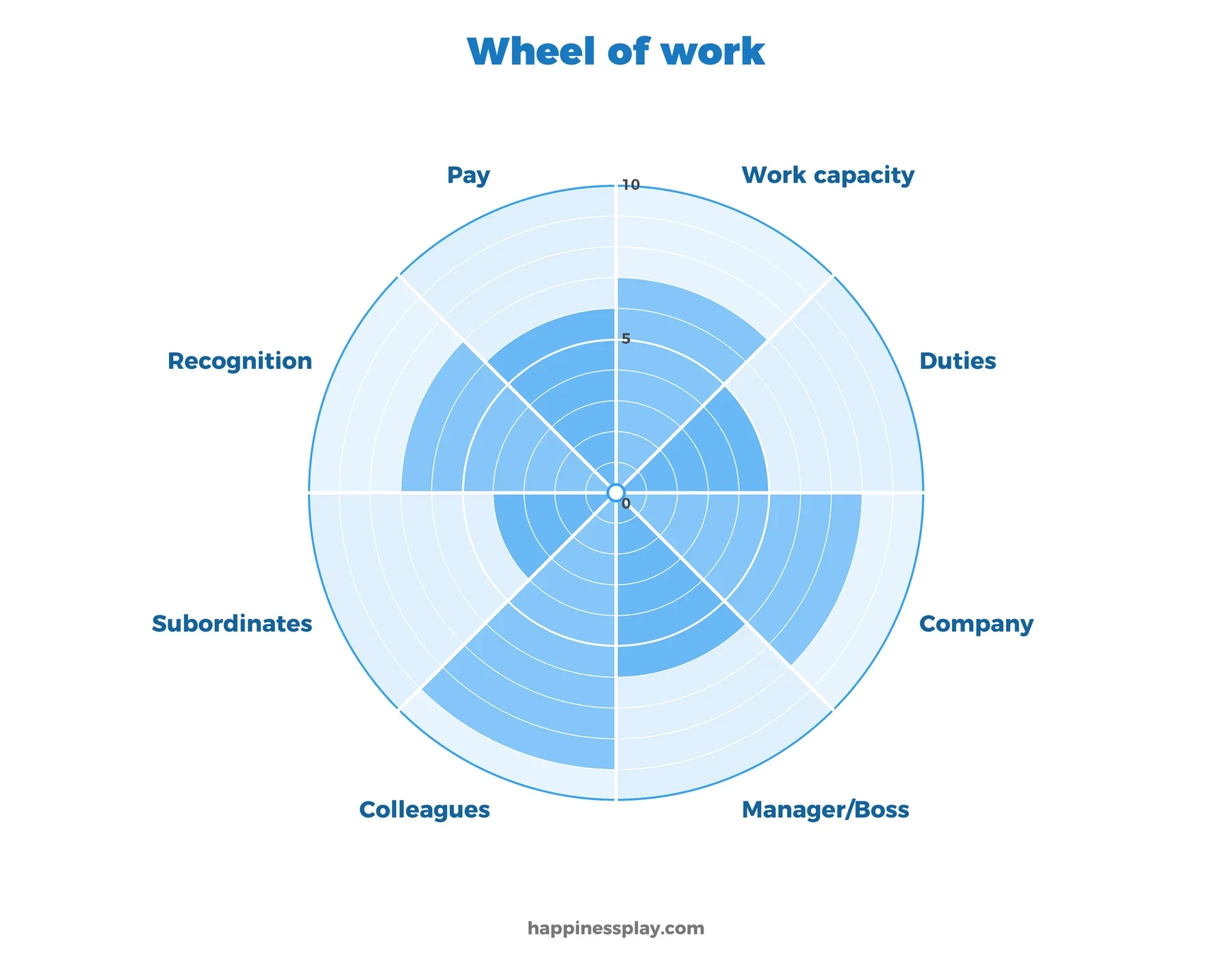
The starting point is the Professional development area of the wheel of life, scored from 0 to 10 according to how satisfied you are today with your work. To look at it more closely, the professional wheel of life (also called the work wheel of life or work wheel) splits work into eight sections: work capacity, duties, company, manager or boss, colleagues, subordinates, recognition and pay.
Examples of professional development conditions: having a creative job, a high dedication to your work, learning to speak in public, receiving ongoing training or having a salary in line with your responsibilities.
Video: how to do the Professional Wheel of Life step by step

Example of the Professional Wheel of Life
Just as the Wheel of Life helps you assess your degree of satisfaction in the different sections of life, as shown in the book “Autocoaching para despertar”, other wheels can be made to analyse other life areas in more detail, such as this professional and work area.
Work Wheel of Life
You will need a blank sheet of paper and to draw a circle divided into eight sectors, as if it were a game piece for Trivial Pursuit. Score each work area (wedge) from zero to ten based on your degree of satisfaction today, with zero being a disaster and ten feeling great. Remember that there is no preset scale: it is a personal one, and what may be very good for a colleague or collaborator may not be for us.
Try not to rack your brain looking for a reference system to work out how to gain one point. If you hesitate, close your eyes and ask yourself: am I truly happy in this area of my work? There are many aspects and tips for improving at work, but it is good to start from a good initial knowledge of how you feel in your job.
In the Work Wheel of Life (professional wheel of life) you assess the work capacity you have and how good you feel about the duties you perform in the organisation (or in your own business) you work for. Score the relationships you have built, checking how you feel about your colleagues, collaborators, subordinates and bosses. A job has to be rewarded with intangible recognition and more tangible pay. If we have no managers or bosses, colleagues or subordinates, we can ask ourselves: do I really feel dissatisfied for not having them? And give a low score if we need them.
These are the areas you will assess in the professional wheel of life:
| Area | Description |
| Work capacity | Am I satisfied with my performance in the work environment? Do I really want to work in what I do? |
| Duties | Am I satisfied with the duties I perform? Am I carrying out tasks that create value for the company? |
| Company | Am I comfortable in my company? Does the company I work for respect my values? |
| Manager/Boss | Am I satisfied with my boss? (or with my role as a boss, as a business owner). |
| Colleagues | How do I currently feel about my colleagues or work collaborators? Do I feel we make a good team? |
| Subordinates | Am I satisfied with how employees are treated in a company? Do I feel they help build a good team? |
| Recognition | Do I feel recognised at work? Do I feel the work I do is valued? |
| Pay | Am I satisfied with the income and other benefits in kind my job brings me? |
Do you have a score for every work area (wedge)? This personal measurement puts your overall view of your professional life into numbers, and you will probably see things differently. Not sure about all the values you chose in the work wheel? Review your scores and change them until you feel comfortable with them. Remember that we never judge a work wheel as good or bad: it is simply yours, personal and non-transferable.
Professional wheel of life template
To finish, draw eight arcs with a thick line, and you should get a figure similar to the one below. A picture is worth a thousand words, so search for “work wheel” on the Internet and you will see that the resulting figure is the outline.
Now is a good moment to start working on the lowest-scoring areas. The downside of coaching or mentoring is that you often lose a lot of time in the initial phase finding the problem, so rest assured that the happiness app, Happiness Play, can help you with these first steps.
When to do the Professional Wheel of Life
- When you arrive at work with no enthusiasm or notice you have been stuck for a while.
- Before a performance review, asking for a raise or changing role or company.
- When looking for a job, to be clear about which conditions you need and which ones motivate you.
- In a workshop for employees: each person does their work wheel and their personal wheel and chooses a first change.
- Every few months, to check whether the changes you set yourself have improved your work.
Coaching exercises for the professional environment
We often feel so afraid of different situations at work that we prefer to hide them and say nothing, but some examples of questions from a coaching perspective will help us in our day-to-day situations. Remember that coaching does not try to teach or give advice: it starts from the idea that the client already has every resource needed to reach their goals.
Here are some examples of how work coaching sessions are carried out; you will see that they ask powerful questions that make the client think about their own actions.
I want to improve the relationships I have in my company
To improve relationships within your company at work you need to consider a series of points:
- What image do you think others have of you in the company?
- Which actions do you need to take to reverse or improve it?
- What can and what can’t you change in those relationships?
- How does the general atmosphere of the company affect your professional relationships?
I want to earn more money and get a higher salary
A pay rise is something we all want in any work environment. Before anything else, I suggest you reflect on:
- Which real options do you have of getting it?
- Which merits have you accumulated to get that raise?
- Which ideas come to mind to achieve it?
- Who can directly influence a decision about a salary increase?
- Who could support you in getting it?
I want to be valued more in my company (by my boss, my colleagues, in other departments)
It is an important question you raise. To increase your worth within the company you should ask yourself:
- What do you expect from others at work?
- What do you think others expect from you at work?
- What would your ideal scenario be for this to happen?
- How could you manage to achieve it?
How can I get my company to give me training?
Training is without doubt a fundamental aspect of performing well. Have you thought about:
- What do you really think the training the company gives you will bring you?
- Are you in the right place to access that training?
- Which professional skills can you put into action to achieve it?
- Is the training you would ask for in line with your professional goals within the company?
I want to create my own company
If you are thinking of setting up a new business and acting as an entrepreneur, we recommend that to start such an adventure you first think about:
- What is your dream project and how much of it is real?
- Have you analysed all the market options well?
- Have you sought professional advice to support you in the process?
- What will happen if things don’t go as you wish? What is your alternative plan (plan B)?
I want to change position or duties within my company
Sometimes people think that to know how to start being happy a change of duties at work is needed. To change position and/or duties within the company, I invite you to take some time and think about:
- Which aspects are you willing to give up to change position, and which are non-negotiable?
- Why is that change so important to you?
- Which factors must your ideal position or department have?
- Which actions can you take to reach your goal?
- Have you considered which skills you need to fit that new position?
How do I get a permanent contract at the company? What can I do?
You are fully entitled to want greater security in your working life, and I suggest you consider:
- Is this a feasible goal?
- What are your motivations for achieving it?
- Who can you count on within the company to help you achieve it?
- Which ideas come to mind to have it now?
- Can you do more to show high performance and be considered?
How to get a job
Facing a demanding search like the one you are carrying out, reflect:
- Have you done everything in your hands to get it, or could you have done something more?
- Which ideas come to mind to reach your ideal in professional life?
- Which skills make you stand out from the rest?
- When are you going to start and which actions are you going to take?
How to change work sector
For a change of sector like the one you propose, I would like you to think carefully about:
- What motivates you to look for opportunities in that sector?
- Have you assessed the requirements to access work in that sector?
- Have you assessed the expectations it creates about that new work sector?
- Which alternatives would you have if you didn’t manage it?
- Which people do you know who could help you?
How to work in what I like
The biggest myth of happiness is thinking that you can be happy anywhere simply by changing your attitude. To be able to work in what excites you, ask yourself the following questions:
- What would motivate you most about that new job?
- How much effort are you willing to put into achieving it?
- How can you overcome the obstacles in your way?
- Who do you know who can help you achieve it?
- Have you thought about the activities and duties that stimulate you professionally?
I want to claim unemployment benefit
To access unemployment benefits I invite you to think about the following reflections:
- Have you gathered all the necessary information?
- Have you assessed whether your expectations fit reality?
- Whether you get it or not, have you considered what you are going to do?
- Have you planned what you are going to use the benefit for?
What do I do so as not to lose my job in difficult times?
Facing uncertainty, I recommend you reflect on:
- Which qualities make you indispensable in your job, and how can you get more out of them?
- Which other alternatives come to mind to keep your job?
- Who can give you support in the company?
- If you lost your job, which options would you have?
What would my ideal job be like?
I notice I am not feeling very well at work… maybe I have problems with my boss, maybe I need to improve my relationship with my colleagues, or maybe I need to think about looking for new professional challenges. Fine, and what are you doing to change the situation? You have surely heard hundreds of times Einstein’s saying “We cannot expect things to change if we always do the same“, and thought: those were other times!
The context is complicated, and the time has come to put complaints aside and simply start listing everything we want at work. Do you really know what you want and what brings you happiness? Even if you don’t have a job right now, have you stopped to think about what your ideal job would be like?
To know what you want at work you first have to design a complete letter to Santa Claus with a list of how you would like your job to be. I mean it: list the things you would want in your job, both the necessary and the optional ones. For example, I have written with my right hand all my life, that is, I am right-handed. But when I injured my right hand and it was put in plaster, I adapted to writing with my left. As it was temporary, I quickly went back to the right, but if it had been for life, I would surely have got used to being left-handed. That is, I have a preference for being right-handed, but that does not mean I could never be left-handed, because it would only be a matter of practice.
It is good to be aware of these preferences. A good trick to discover them is to ask yourself, for example, what led you to feel dissatisfied with your last job. That will tell you which things you pay most attention to. For example, I have met people who can’t stand travelling for work, or never want to be called in at weekends, or want to be very close to home. Regarding a person’s tastes, nothing is written, but surely you can already list your preferences without much difficulty. It is very important that you don’t limit yourself, and that you include everything you would like. Life will put the limits on us, but don’t try to put them there ahead of time.
My ideal job
As an example, here is a letter to Santa Claus for work, already organised with the list of preferences or necessary and motivating conditions.
Necessary conditions
- That my boss gives me confidence and makes me feel motivated (well-defined types of power).
- That the salary is in line with my work responsibilities.
- That there is a good level of fellowship and that people know the difference between a threat and a warning.
- That I learn things that are useful to me.
- That they involve me in tasks and keep me away from people who break the rules.
- That it offers me continuous training.
- …
Motivating conditions
- That my company is stable and well known.
- That they reward my successes, perhaps with some kind of work party?
- That it offers extra benefits such as meal vouchers or health insurance.
- That it has a good office, and if possible with a yellow background, which I like so much.
- That they value employees above profits (perhaps it is good to do some values exercises).
In addition, there is nothing better than relying on the Happiness Play tool, which gives you the best initial support for going to sessions with professionals who have more knowledge, and also accompanies you throughout the whole process. This way you will enjoy the Autocoaching methodology first-hand and more effectively. Are you up for it? Enjoy the tutorial video and you will see how easy it is to improve at work. Cheer up!
How can I improve in my job?
Factor classifier
It is important to work in detail on the list of factors set out in the letter to Santa Claus to improve our level of awareness (long live happy workers!). First you have to classify them as necessary or motivating and then order them by importance. The first classification will help you distinguish between the things you imperatively need (necessary factor) and those you would like to have (motivating factor) to be happy in that area of your life. In the second step, order each factor from most to least important, that is, from what you want most to what you want least, to detect what you should never give up in your happiness.
Happiness Play helps you at work
Here we want to show you an example from the professional sphere of one of our clients. It is very easy to use the happiness app for the workplace!
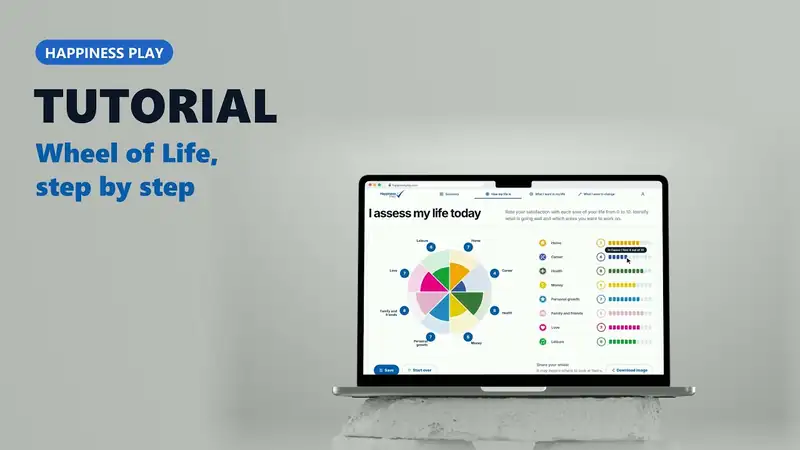
Video text: Using the Wheel of Life I start by taking an initial snapshot of my happiness. I score myself from zero to 10 in each area, zero being a disaster and ten wonderful. I indicate how I feel in the areas of my life: health, personal growth, leisure, family, and love… work!, as complicated as it is to get a job now.
In this case I notice I am not feeling very well at work… I need to start reflecting a bit more on this particular area. Maybe I have problems with my boss, maybe I need to improve my relationship with my colleagues, or maybe I need to think about looking for new professional challenges. Well… time to meditate! Mmm… I like this! With the happiness snapshot in front of me, it helps to ask myself: how do I want my professional life to be?
It is very common to answer something generic, like “that I like my job“, since it lets me start any job. But how quickly the problems appear, and how complicated things get when it comes to looking for a job that really motivates me every day! Following the Autocoaching methodology, the application lets me list in detail the things I want in my professional life, as if I were writing a letter to Santa Claus. Who is going to tell me what my job should be like? I know myself well enough, so I am the one who knows best what I want. The best part is that with the system I can rely on more than 250,000 options collected after years of research. I can pick from the drop-downs and check ideas as I go, or simply search directly for what I want in the search box. Of course, if my desired option is not there, I can easily add it.
The next step makes me reflect a little more: what is my life like now? I have to review the whole list and indicate what is met and what is not. If everything were met, I would have given myself a ten, so if I see there are things I haven’t detailed, I would have to go back to the previous step and include everything I want.
Great, now it is time to put my letter to Santa Claus in order. It is easy to tell the truth, and when we list everything, some things are mere complementary details. I like that Happiness Play makes me think at this level of detail, because I realise it is the necessary things I really have to pay attention to in order to improve my happiness in this area.
What do I want to change in my job? It is clear that now is a good moment to put complaining aside and start setting myself actions that help me be happier. It is not worth blaming the company, the boss or the whole world. I love it because the system includes more than 10,000 suggested changes, which always give me perspectives and ideas I hadn’t considered. Excellent! I am going to set this change… I commit to a date and also indicate the kind of reward I will give myself… I deserve it! It is fun, and the application is going to send me an email to remind me of my commitment to change.
Finally I include a global idea of how I see myself in the future. I write how I would like to see myself in a few years; the truth is that in a while I see myself doing very well at work!
I love the application, because I can log in and change the things I have marked as my tastes change. I feel supported, and whenever I want I get a report with the most important data, which I share with a professional who helps me achieve the changes with some coaching tools.
The truth is that I feel very fortunate to have access to Happiness Play, a simple and complete application that really helps me be happier.
You can start managing happiness at work with Happiness Play by clicking here.
If work coaching interests you, check how your professional development wheel looks
Work and career: quick answers
Is the professional wheel enough to decide whether to change jobs?
On its own, no. It shows how satisfied you are with each part of your working life today. To decide, add a values exercise to clarify what matters to you at work, and a life map to see how work fits with the other areas of your life.
Are happy employees automatically more productive?
It is a popular belief, but it is not that simple. We go through it in common myths about happiness at work, and in this overview of what is known about happiness you will find the research behind it.
Where does this method come from?
It belongs to the Autocoaching methodology, which turns coaching questions into exercises you can do alone. You can start with the free wheel of life and its template and come back here for the work area.
Whatever you decide, write it down and give it a date. A clear next step beats a perfect plan, and you can always repeat the wheel in a few weeks to see what moved.
If you are just getting started, read how to start being happy. To turn the answers into a plan, use these coaching tools for managing a change. For better questions, read weak vs powerful coaching questions. To see what coaching is, read how to explain what coaching is. To put it into practice, read how to make changes in your life.
After this wheel of life you can also do more sub-wheels from the life map
Each sub-wheel breaks one area of your life into eight parts so you can score it in detail:
 Love and relationships
 Money and finances
 Home and living space
 Family and friends
 Health and habits
 Leisure and free time
 Personal growth
 The wheel of life

