

These are the coaching tools that coaches use every day, and they are just as useful if you are working on your own life. Whether you plan to study coaching or simply want to make a change stick, keep these four within reach: a change manager, a goal setter, a perspective generator and an action plan. Use them in that order and a vague wish becomes something you can start on Monday.
| Tool | Question it answers | Output |
| Change manager | What exactly do I want to change, and by when? | A concrete, dated change |
| Goal setter (SMART) | Is my goal clear, measurable and realistic? | A sharp goal in positive terms |
| Perspective generator | Which options do I have, and what does each cost? | One chosen scenario |
| Action plan | What do I do first, and when? | Dated steps and checkpoints |
How to manage a change
A change is easier to carry out when you write down its main components:
- Description: one sentence that states the change as concretely, objectively and measurably as possible.
- Goal: what you want to achieve. You will define it better later with the goal setter below.
- Scenarios or options: there are usually several ways to reach the goal. List them, with the obstacles and the help you can expect in each. The perspective generator below helps you compare them.
- Date: when you commit to having the change finished.
- Reward: optionally, a prize you give yourself when you succeed.
- Reminders: whatever keeps the goal in front of you, such as a sticky note, a phone alarm or a calendar entry.
A worked example: improving your health score
Imagine someone who wants to raise their health area from a 6 to a 7. They commit to improving their fitness by going from 80 to 75 kilos (a concrete, measurable goal) within five months (a fixed date). They consider three options:
- Go to a gym near home at least twice a week.
- See a dietitian and improve their eating.
- Make the last meal of the day a light one.
They will weigh themselves every week and write it on a sticky note (reminder), and when they reach the goal they will buy themselves a good book (reward). In practice the options are often mutually exclusive, so you need to think about the opportunity cost. Suppose they choose the first option and list the actions that lead to success:
- Without excuses, leave the office early on Tuesdays to go to the gym.
- Reserve Sunday morning to go early and then enjoy the sauna.
- Weigh in every week and check that the number goes down gradually.
They also note the gym days in their calendar, which is one more reminder. You can see how real conversations work in our 12 good coaching conversations.
How to manage goals
Setting goals properly is critical to reaching them. If a goal is not realistic there is no hope, but if it is not challenging there is no motivation. The word SMART is a good memory aid for the essential qualities of any goal: Specific, Measurable, Achievable, Realistic and Time-phased. Ask yourself:
- Specific: do I know in detail what I want to achieve? No ambiguity. A goal is clear enough if another competent person could reach the same goal.
- Measurable: can I assess my progress? Remember, you cannot achieve what you cannot manage with a good dashboard. It can be a powerful computer or a chart full of pins on the wall.
- Achievable: can I reach the goal in my current situation? A challenge is good, but it has to be within reach of the means you have.
- Realistic: is the goal relevant to my purpose in life? There are many things you could do; the real question is whether you should. If you are not sure about your purpose, try our life purpose exercise.
- Time-phased: what is my deadline? Build a timeline with the milestones on the way to the goal.
Say it in positive terms
State goals positively, because otherwise you focus on the negative. Instead of “I must not fail the exam”, say “I want to pass the exam”. You tend to get what you concentrate on, so if you focus on the fear of failing, that is what you feed. Focus on what you want, not on what you do not want. An effective way to shift attention is to change the questions you usually ask yourself: what do I want? What would I prefer to have instead of what I have?
Tangible goals such as “I want a new job” (a good moment to look at the work wheel) or “I want a new car” are easy to specify. Abstract ones such as “I want to improve my relationships” or “I want to earn more” are harder, so make them as specific as you can. If you want more confidence, for example, it may mean speaking in public for ten minutes without cold sweats and without losing sleep the night before. Useful questions: what exactly do I want? Can I describe it more precisely? What will I see, hear and feel when I reach it? How long do I need? By when do I want it?
Also decide beforehand how you will measure your progress: how will I measure it, how often, and how will I know I have reached it?
How to manage the perspectives on a change
Whenever you plan a change, you have several ways to achieve it. Open up as many perspectives as you can, let your imagination run, however impossible they may sound when you first say them. It helps to be someone who listens to what others say. With the list in hand, think about the advantages and drawbacks of each option: what are the pros and cons? What good and bad consequences would each have? You always gain and lose something, however much you resist seeing it.
Here is a simple example of generating scenarios for a desired change: practising three more hours of leisure per week. We often improvise the first thing that comes to mind, but is it really the best option? A few minutes of thought usually helps you choose better. As a rule, list as many options as you can, and include the option of doing nothing.
| Change: practise three more hours of leisure a week | |||
| Scenario 1: go out with friends | Scenario 2: watch television | ||
| Pros (+) | Cons (-) | Pros (+) | Cons (-) |
| You make new friends or strengthen existing ones; new experiences | It usually costs money (time to check the money wheel) | You can see interesting things; very cheap | It dulls the mind and encourages a sedentary life |
| Scenario 3: go to the gym | Scenario 4: do nothing | ||
| Pros (+) | Cons (-) | Pros (+) | Cons (-) |
| Better physical and mental fitness; you may make friends | It takes consistency | No thinking; it is free | The goal is not reached; frustration grows |
Every scenario should have at least one point in favour and one against. It is not always easy to find them, but make the effort, because we unconsciously tend not to see problems with our favourite option. It is easier to see all the pros and cons when you are not involved in the problem, so ask a friend, a relative or your coach. Once the table is complete, choose. If the pros and cons leave you in doubt, choosing will be harder. People’s tastes vary a lot, and whether you like it or not there is almost always an opportunity cost for the options you drop.
How to build an action plan
Goals lead nowhere without an action plan, because the plan sets the steps you need. A good plan starts from a long-term goal and breaks it down into intermediate objectives. For example, if your goal is to increase sales by 20% by the end of the year, work out how many new clients you need each quarter, each month and each week. The idea is to split the final objective into milestones over time. In a plan, questions that start with “when” are the most useful.
Every action in the plan needs a date and a follow-up indicator that shows whether you are on track. Everything begins with a first step: step by step you build a road, and day by day you build a life. Do not wait to start.
Also think about the risks of each intermediate objective. Not everything goes well, and the more possibilities you have thought through beforehand, the better you can handle them. The biggest source of stress when reaching goals usually comes from facing uncertainty you did not plan for. If a step carries a high risk of keeping you from finishing on time, prepare a contingency plan, or even a counter-offer that gets you something similar if the original goal turns out to be out of reach. The aim is to handle changes with skill, without sliding into despair.
Frequently asked questions
Do I need a coach to use these tools?
No. They are designed so that you can work through them alone, and you can add a coach or a friend later. The questions you ask yourself matter more than the template.
Which tool should I use first?
Start with the change manager to describe the change, then the goal setter, then the perspectives, and finish with the action plan. If you are not sure what to change, first score the eight areas with the wheel of life.
How is this different from a to-do list?
A to-do list tells you what to do; these tools help you decide what is worth doing and why. They also build in a date, a review and a plan B.
You can find more tools in the free blog-book Conseguir la Felicidad, or start using the Happiness Play platform to manage your happiness.
If you are a coach, see how to get more coaching clients. For better questions, read weak vs powerful coaching questions. For more ideas, read how to live without stress.
Or explore one area at a time:
 Work wheel
 Family and friends wheel
 Health wheel
 Love wheel
 Money wheel
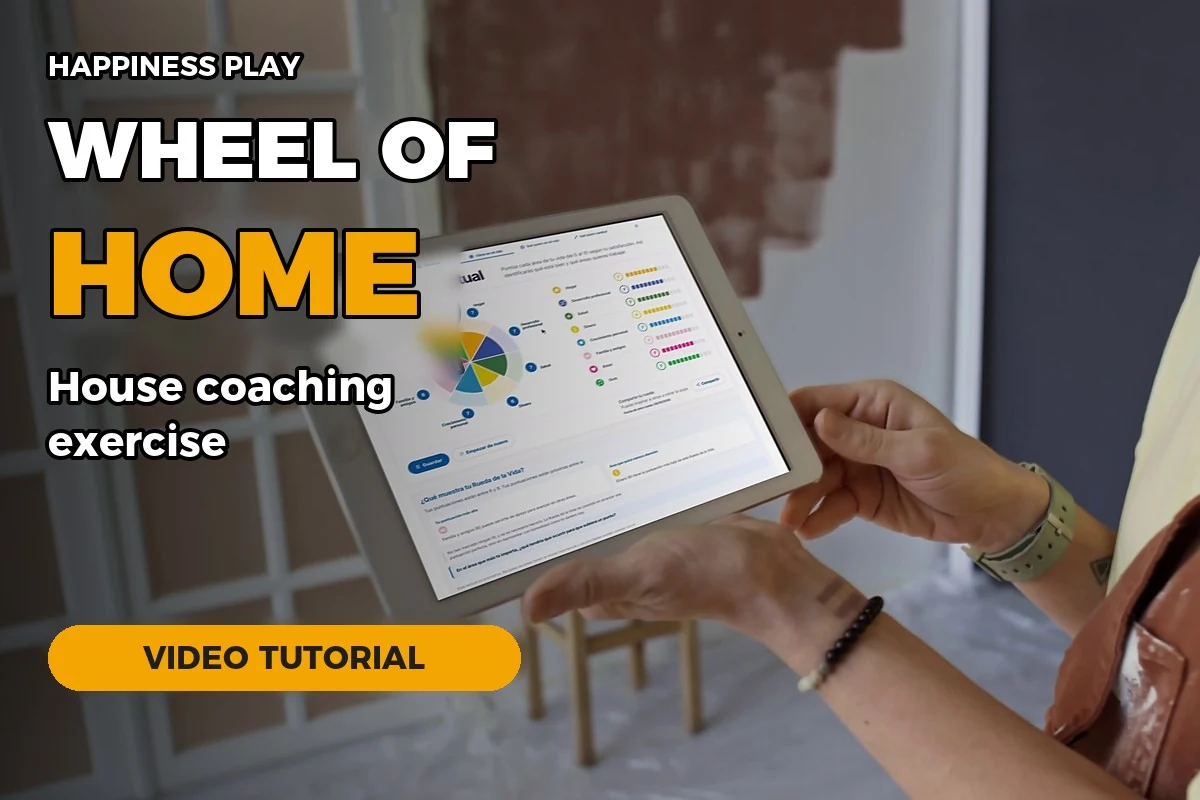 Home wheel
 Leisure wheel
 Personal growth wheel

