


Love is the one area where almost everyone feels they should already know the answer, and almost nobody does. This wheel does not judge your relationship: it simply lets you see, in eight scores, where it is strong and where it needs attention.
The love wheel is a couples coaching exercise: you score eight areas of your love life from 0 to 10 (capacity to love, number of relationships, duration, communication, living together, fidelity, sexual passion and emotional passion) and see at a glance what is working and what is worth working on. It is useful whether or not you have a partner, and it is a good starting point for resolving conflicts or for understanding a relationship crisis before deciding what to do.
Video: how to do the Love Wheel step by step

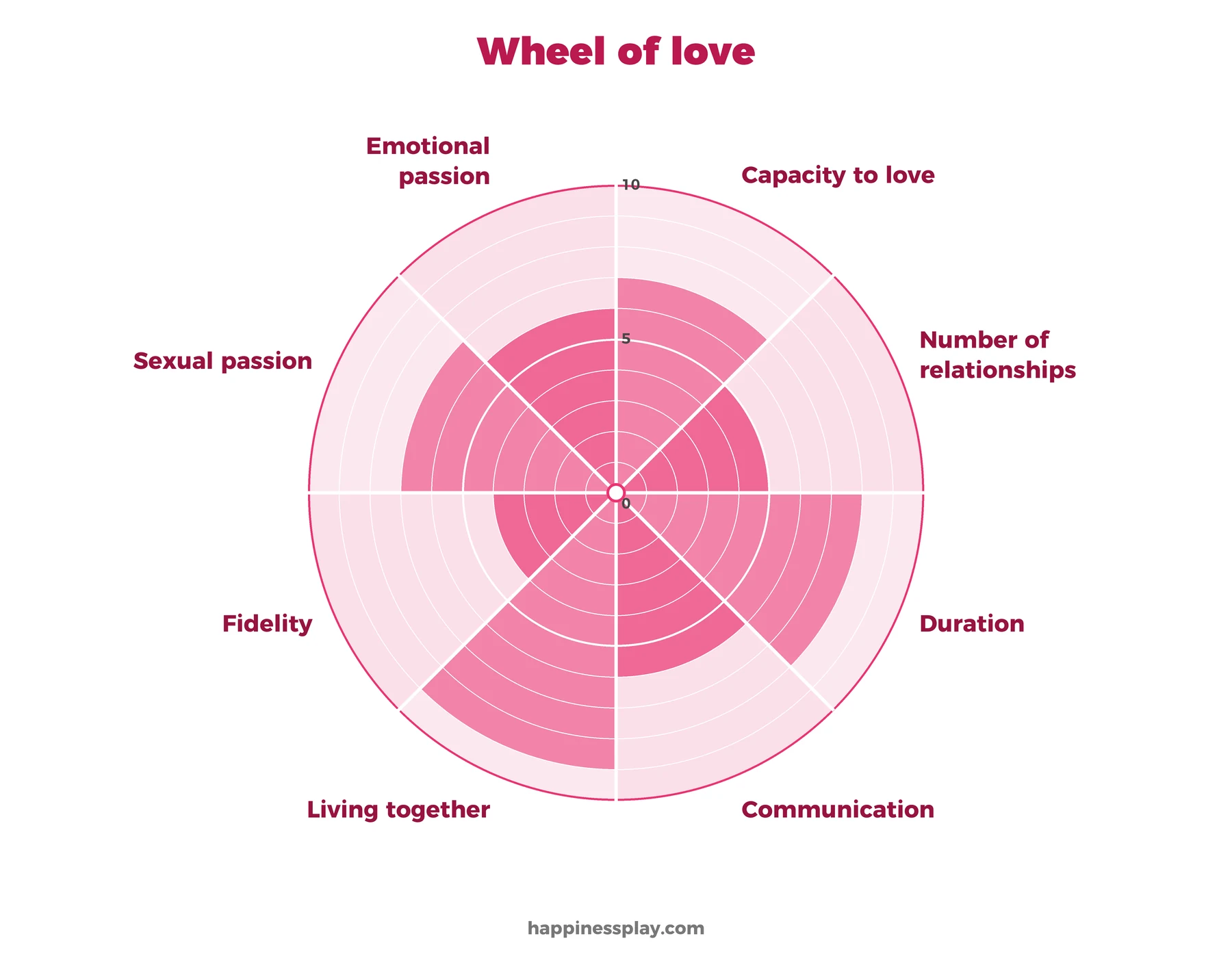
Example of the Love Wheel of Life
If you are looking for exercises for couples to improve your relationship, you are in the right place. Many people are afraid to face their demons and prefer to stay in their comfort zone. But it is time to take personal responsibility and start being happy by discovering everything that makes your heart beat (and also everything you don’t like).
As in any wheel of life, you will need a blank sheet of paper and a circle divided into eight sectors, as shown in the figure. Score each wedge (area) from zero to ten according to how satisfied you are today. There is no preset scale: it is a personal one. Try not to rack your brain looking for a reference system to work out how to gain one more point. If you hesitate, close your eyes and ask yourself: am I truly happy in this area of my life?
The Love Wheel
In the Love Wheel it is important to assess your capacity to love and whether you have the number of relationships you want. Consider whether their duration and frequency are what you want, bearing in mind that they need good communication, a good life together and fidelity with your partner. Remember that an emotional connection (romantic passion) and a physical one (sexual passion) are essential.
For every score in these wedges, nobody judges whether you have a single partner or several partners with whom you never settle into anything stable: all that matters is what you feel at each moment, and what makes you happy. These are the areas to assess when you want to start couples coaching:
| Area | Description of the area of the love wheel |
| Capacity to love | Am I satisfied with my ability to have romantic relationships? Do I truly give myself, or do I give just what is needed? |
| Number of relationships | Am I satisfied with the number of romantic relationships I have? Do I feel I would like to have other relationships as well? |
| Duration | Am I happy with how long my relationships last? Do I do things to keep my partner and give the relationship stability? |
| Communication | Am I satisfied with how we communicate? Do I get along well with my partner? |
| Living together | Are we compatible under the same roof? Do we know how to live together? Do we share the household chores in a way that works for both of us? |
| Fidelity | Do I feel there is fidelity in my relationships? Do I trust that my partner is not cheating on me? |
| Sexual passion | Am I satisfied with the quality and frequency of sex in my romantic relationships? Am I truly attracted to my partner physically? |
| Emotional passion | Do I feel truly loved? Do I value my partner’s mind and emotions in a positive way? |
Do you have a score for every area? This measurement puts your overall view of life into numbers, and you will probably see things differently. Not sure about all the values you chose? Review your scores and change them until you feel comfortable with them. Remember that we never judge a wheel as good or bad: it is simply yours, personal and non-transferable. In the template below you can see how the arcs should look once the scores are in.
If couples coaching interests you, first see how your love wheel looks
Questions about the love wheel
Can I do the love wheel without a partner?
Yes. It also covers your capacity to love and your relationship history, so it works for singles too. Pair it with a values exercise to be clear about what you want from a partner.
Should my partner and I do it together?
It works best if each of you fills in your own wheel first and then compares notes. Where your scores differ is where the conversation starts. If you want ideas for those talks, see the best information about happiness and the life map exercise to place the relationship in the bigger picture.
Remember that a low score is not a verdict on your relationship, only on how you feel about it today. Choose one small change, try it for a few weeks, and score again.
If you are just getting started, read how to start being happy. For better questions, read weak vs powerful coaching questions.
After this wheel of life you can also do more sub-wheels from the life map
Each sub-wheel breaks one area of your life into eight parts so you can score it in detail:
 Work and career
 Money and finances
 Home and living space
 Family and friends
 Health and habits
 Leisure and free time
 Personal growth
 The wheel of life
Love wheel template
You don’t need to know what an algorithm is to know it is a good moment to start working on the lowest-scoring areas. Perhaps some relationship coaching? Activities to improve your relationship? A couples exercise? Rest assured that the happiness app, Happiness Play, can help you: you can start with these love coaching questions.
When to do the Love Wheel
- Before starting couples coaching, to know where you are starting from.
- In a relationship crisis, to see which areas weigh the most and avoid arguing about everything at once.
- Before a difficult conversation: each of you does it on your own, then compare the two wheels.
- Every few months, to see how the relationship is evolving.
Coaching exercises for couples
We often feel so afraid in certain situations that we prefer to hide them and say nothing. Examples of questions and conversations that start from a coaching perspective can help us in everyday situations. Remember that coaching does not try to teach or give advice: it starts from the idea that the client already has every resource needed to reach their goals. Below are some examples of how love coaching sessions work; you will see that they ask powerful questions that make the client think about their own actions.
How can I improve communication with my partner?
Communication is without doubt an essential part of any relationship. I suggest you research online, read specialised books and look for specific courses. For my part, I would like to ask you a few questions that will surely help you reach your goals:
- What expectations are you holding?
- What do you want to build in your relationship?
- Imagine you could find what you are looking for: what would it be like to have it? Could you plan the steps to take?
- If you truly want it, when are you going to start?
How to resolve conflicts with my partner
I agree that conflict resolution is a skill that will serve you well when living together, and perhaps it is a good moment to work on a values exercise. I encourage you to work on it, and nothing helps more than answering these questions:
- Which qualities have you not been using to resolve conflicts? Which ones do you think you will use from now on?
- Which necessary and motivating factors (conditions) will help you achieve it?
- What will you do to take one more step toward your goal? What do you need your partner to do?
- If you are 100% committed, when will you start?
I want to be happy with my partner
Some happiness framework can surely help you start being happy. I share with you how complicated this situation can be, and how important it is not to be stuck in it. To reach your goal, I suggest you answer these questions:
- Have you considered looking for the positive aspects and the lessons in it?
- Which values do you share with your partner? And which common interests?
- Have you considered how committed you are to doing it?
- To what extent do you think the relationship can improve? Which personal skills can help you achieve it?
- When and how are you going to get started?
How can I improve my relationship?
Finding a way to get along well within the relationship can be hard work, but it can bring many benefits. Besides encouraging you to do it, I would like to put a few questions to you to make it easier:
- What is your current situation?
- What is your ideal relationship?
- How can you use your skills to bring your current relationship closer to the ideal one? How can your partner help you?
- If you are truly committed, what are you going to do, and when?
I want to be passionate and desirable in my relationship
Seasoning a relationship with ingredients like passion and desire can make it very tasty. To mix the ingredients well, so that none overpowers the other flavours, I recommend you answer these questions:
- Which expectations are you putting on the fire? Are you sure you share the same taste in food?
- Which abilities of yours are you not using to make things better? What do you lack to turn up the heat?
- Imagine you have already done it: how would it feel? Which recipes have you invented for it, and how has your partner helped?
- What are you going to cook, and when are you going to start?
How to end the relationship with my partner
This is a very delicate matter, and perhaps you realised it after doing the love wheel (or your life map). I suggest you spend a few minutes thinking about these questions so you can find the best way through:
- Are you really sure of what you want? Have you thought about what you will gain and lose?
- Which tools do you need: plans, courage, pride, self-esteem? And above all, how can you do it without making anyone feel guilty or ashamed?
- Imagine you have already done it: how does it feel? Which steps did you take to get there?
- If your commitment is real, when are you going to do it?
How to learn to manage conflicts in my new relationships
That is a question complicated enough to spend a few minutes reflecting on the questions I am about to put to you:
- In moderation, conflicts and problems can be a source of growth. Have you considered looking for what they can teach you?
- To what extent do you think you can achieve what you set out to do? Which personal skills can help you?
- Have you considered how committed you are to doing it? Are you motivated enough?
- When and how are you going to get started?
I need to live with my partner: what can I do?
This is one of the critical points in a relationship. To improve it, I suggest you gather all the information you can online and in specialised books, as it will be very useful. For my part, I would like to ask you a few questions that I am sure will help:
- What kind of living arrangement do you have: agreed together, or did it simply happen?
- What do you value about the relationship? What do you like most? Do you share the same tastes?
- Which things do you want to improve, and how can you do it?
- When are you going to do it? Will you do it alone or with your partner?
We suggest you do the free wheel of life template together with your partner… you will discover new perspectives!
I want to find a partner for life
To improve your relationships, I suggest you start by using and paying attention to these communication tools: listening, assertiveness and empathy. It will also help to reflect on these questions:
- Is it possible that you have neglected your “wish list” for love? Which wishes could help you reach your goal?
- Which ideas come to mind to make better use of your inner motivations? And your personal resources?
- How will your relationship improve if you succeed? How can you plan your way toward the goal?
- When are you going to do it?
I want to have new relationships
You will surely find some ideas to guide your uncertainty if you answer these questions honestly:
- Which strengths do you have? How can they help you develop your weaker areas?
- Do you know what kind of relationship you are looking for?
- How flexible and tolerant are you when looking for new partners? How could you strengthen that so it works in your favour?
- When are you going to get down to work?

