


Money worries rarely stay in one corner of life: they leak into sleep, relationships and plans. Before looking at products or budgets, this wheel asks a simpler question, how do you feel about your money today, and what would a better situation look like?
Financial coaching is a process of questions that helps you decide what you want from your money and what the first step toward it is. A financial coach does not tell you what to invest in or what to spend on: they help you see clearly what works in your personal finances, what is missing and which change depends on you.
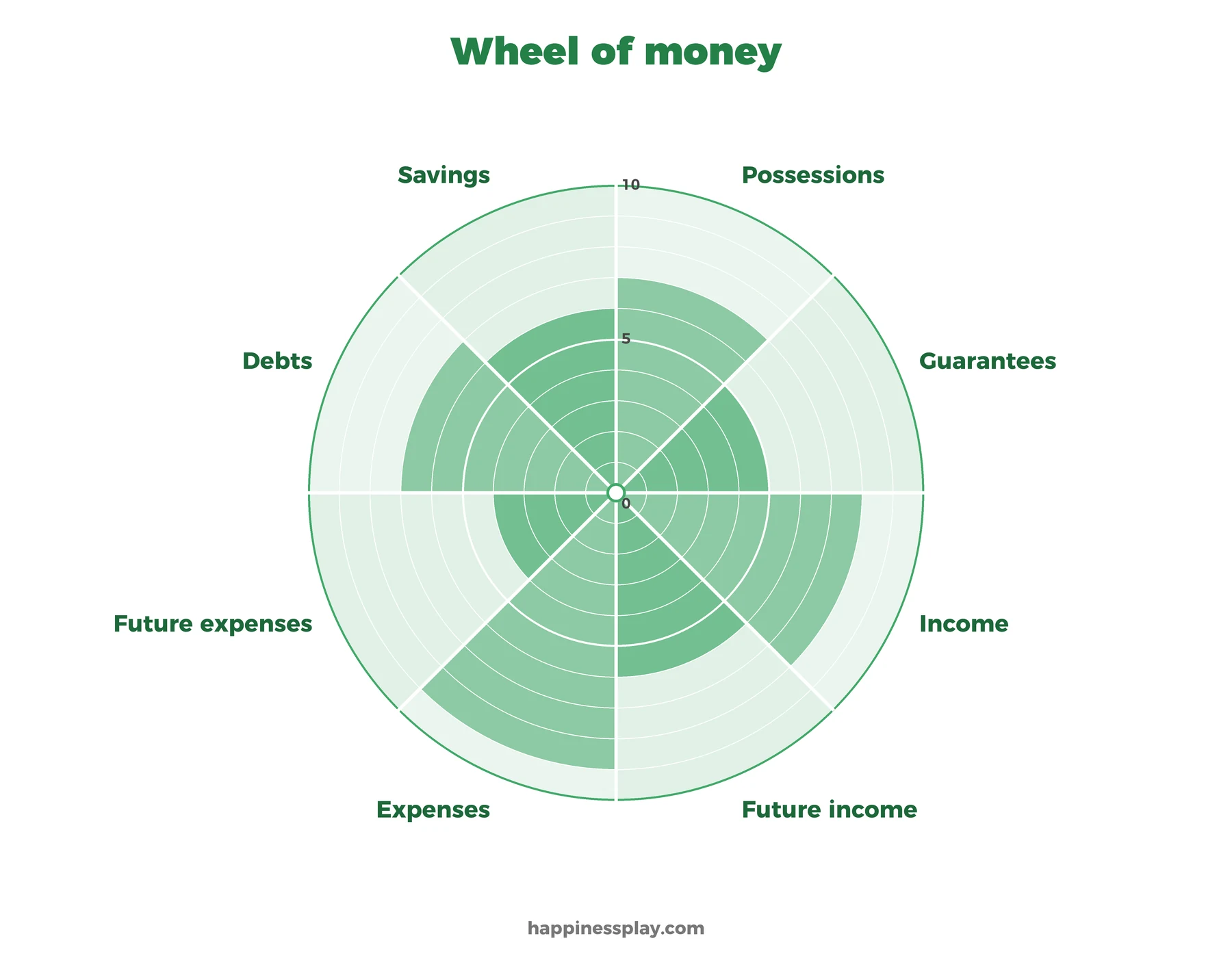
The starting point is the Money area of the wheel of life, scored from 0 to 10 according to how satisfied you are today with your financial situation. To look at it more closely, the financial wheel (also called the money wheel) splits your economy into eight areas: possessions, guarantees, income, future income, expenses, future expenses, debts and savings.
Examples of money conditions: knowing how to save, being able to enjoy your money, having a cushion for the unexpected, having no debts or having an income that covers your expenses.
Video: how to do the Financial Wheel step by step

Example of the Money Wheel of Life
If you are looking for exercises to improve your financial situation, you are in the right place. Here you will find a simple exercise to assess your finances, plus personal finance questions that will help you improve your economic activity. Many people are afraid to face their demons and prefer to stay in their comfort zone. But it is time to take personal responsibility and start being happy.
Just as the wheel of life helps you assess how satisfied you are in the different areas of your life, you can make other wheels, as the book “Autocoaching para despertar” shows, to look in more detail at specific areas.
For this money exercise you will need a blank sheet of paper and a circle divided into eight sectors, as shown in the figure. Score each area from zero to ten according to how satisfied you are today. There is no preset scale: it is a personal one. Try not to rack your brain looking for a reference system to work out how to gain one more point. If you hesitate, close your eyes and ask yourself: am I truly happy in this area of my life?
The Money Wheel
In the Money Wheel it is important to assess whether you have some possessions to start from, however few, and some guarantees that give you a degree of security. Your job or your property brings in current income and lets you foresee future income. Every day you have expenses, fixed or variable, and with time you can plan future expenses. You may also have built up some debts, or have savings from the past.
| Area | Description of the area of the money wheel |
| Possessions | How do I feel about the possessions I have? Do I really need and enjoy everything I own? |
| Guarantees | Do I have guarantees that back me up financially? Do I feel I have enough security? Do I have financial support? |
| Income | Am I satisfied with my current income? Do I think it is enough for the standard of living I need? Do I earn the minimum salary I believe I deserve? |
| Future income | Am I satisfied with the income I expect in the future? Are my prospects for financial growth promising? |
| Expenses | How do I feel about my level of spending? Do I feel I spend beyond my means? |
| Future expenses | Do I expect many expenses in the future? Do I feel I will not be able to cover my future bills? |
| Debts | Am I satisfied with my level of debt? Do I feel very stressed by all my financial commitments? |
| Savings | Do I put some money aside for the bad times? Am I happy with my savings? |
Do you have a score for every area? Not sure about all the values you chose? Review your scores and change them until you feel comfortable with them. Remember that we never judge a wheel as good or bad: it is simply yours, personal and non-transferable.
If financial coaching interests you, start by drawing your money wheel
Money and finances: frequently asked questions
Does the money wheel tell me how to invest?
No. It is a coaching exercise, not financial advice. It helps you describe what you want from your money, and then you can decide what help you need. To see how finances connect with the rest of your life, draw a life map.
How is a financial goal different from a dream?
A goal has a date and a first step. If you are still looking for the dream behind it, try the life purpose exercise, then come back and put numbers on it.
Can more money make me happier?
It depends on what you want it for, which is why research on happiness and income is worth reading with care. Our guide to scoring the eight areas of your wheel of life shows how to compare money with the other areas.
Pick one number to improve first, whether it is saving a little each month or finally listing your debts, and let the wheel tell you in a month whether it helped.
For better questions, read weak vs powerful coaching questions. To see what coaching is, read how to explain what coaching is.
After this wheel of life you can also do more sub-wheels from the life map
Each sub-wheel breaks one area of your life into eight parts so you can score it in detail:
 Work and career
 Love and relationships
 Home and living space
 Family and friends
 Health and habits
 Leisure and free time
 Personal growth
 The wheel of life
Money wheel template
When to do the Money Wheel
- When you barely make it to the end of the month or don’t know where your money goes.
- Before an important financial decision: a loan, a mortgage, an investment or a change of job.
- At the start of the year or after a change in income, to decide how much you want to save and what you want to spend on.
- When debts or expenses keep you awake at night and you need to see where to start.
- Every few months, to check whether the changes you planned have improved your personal finances.
You don’t need to know what an algorithm is to know it is a good moment to start working on the lowest-scoring areas and to begin with a few questions about money. Perhaps some financial coaching? Activities to learn to save? An exercise to invest better? Rest assured that the happiness app, Happiness Play, can help you: you can start with these financial coaching questions.
Financial coaching exercises
A financial coach is the person who accompanies you, with questions, so that you put your personal finances in order. Now that you know what financial coaching is, have you wondered which questions and conversations can help you get started? What could give you more happiness in the way you manage your money?
Some frequent questions about money, asked from a coaching perspective, will help us in everyday situations. Remember that coaching does not try to teach or give advice: it starts from the idea that the client already has every resource needed to reach their goals.
Below are some examples of how financial coaching sessions work (here is a coaching session; you will see that they ask powerful questions that make the client think about their own actions.
I want to have income
In the situation we are in, I share with you how important this goal is. To help you reach it, I suggest you pay attention to the questions I am about to ask and to the answers that come up:
- Have you checked whether your expectations are reasonable? How much income do you want?
- How many different ways can you think of to earn income?
- Of the things you like to do, which could bring you income?
- Which ideas have you come up with, and when are you going to put them into practice?
I would like to increase or multiply my income
If what you have done so far has not worked, perhaps it is a good time to remember that to change your mind is a sign of wisdom. So, for this goal, I suggest you pay attention to the questions I am about to ask:
- How realistic are your expectations and your motivations?
- What kind of relationship do you have with money? What does it symbolise for you?
- Which activities could you start to increase your income?
- How can you get advice to reach your goal? Who can help you?
- What are you going to do to get started and reach your goal?
I would like to find a new source of income
To reach this goal, you may be tempted to look for new investments in things you know nothing about. To apply some financial coaching reflections, I suggest you pay attention to the questions I am about to ask:
- Are your expectations and motivations in line with reality?
- Which activities could you set up to get a new source of income?
- If you could achieve it right now, which dreams for the future would you see fulfilled? Which actions do you see yourself doing?
- Is there anyone who can advise or help you to reach your goal?
- What are you going to do to get started and reach your goal?
I want to learn to manage my income properly
Knowing how to increase your personal income is very important, but you must not forget to manage it properly so the effort is not wasted. To reach the goal you set yourself, I suggest you reflect on the questions I am about to ask:
- Are you realistic when you set expectations?
- Which necessary and motivating factors (conditions) can help you?
- How have you thought about learning to manage your income?
- When and how are you going to set out to reach your goal?
I want to have no expenses
Personal financial coaching can help you with this important matter. To reach the goal you set yourself, I suggest you pay attention to the answers that come out of the questions I am about to ask, which are typical of personal financial coaching:
- Are you sure you can achieve it? What motivates you to do it?
- Have you thought about what you will gain and what you will lose by doing it?
- Which planning and administration options come to mind to reach your goal? Can anyone help or advise you?
- When and how are you going to do it?
I want to improve my control of spending
This seems important enough for you to spend a few minutes thinking about the questions I am asking. Perhaps you can find simple solutions, or consider other alternatives. To find the best solution to reach your goal:
- Are your expectations reasonable? How real is your chance of doing it?
- Which resources can you use to change the way you manage your money?
- Imagine you have already achieved it: how did you plan it? Which actions can you start right now?
- Remember to always tell the truth. When are you going to get started?
I want to have no debts
Some people want no debts and fear the yellow or the green because they associate them with money. This financial coaching goal is important enough for you to take a few minutes to reflect on how to achieve it. The best thing is to analyse and answer the following questions:
- Are your expectations in line with your current situation?
- Have you thought about all the options you have to pay off your debts or to stop going further into debt?
- Which planning and administration options come to mind to achieve it? Can anyone help or advise you?
- When and how are you going to do it?
I want to learn not to get into debt
A basic point for good personal finances. Learning can be an uneven journey; to make the most of it, I suggest you spend a few minutes being honest with yourself about these questions and find the best solution to reach your goal:
- Do you truly have the attitude and the willingness to do it?
- Which personal resources and skills do you have to achieve it? And which motivations?
- Which different ways come to mind to achieve it? Who can help or advise you? Which action(s) can you start right now?
- When are you going to start?
How can I stop crises from affecting me financially?
There are plenty of personal finance examples, but reality is what you live first-hand. Since we are facing a completely unpredictable economic situation, I suggest you reflect on the questions I am about to ask, which will surely give you the answers you need to move toward your goal:
- How real are your expectations? (the professional wheel of life will surely help you see it)
- Which resources do you have to face this situation? Can you think of other alternatives that could help?
- Who can help or advise you on this subject? Is there somewhere you can go for advice?
- Think: what else do you need to face this challenge? When you are ready, when are you going to do it?
How can I invest my money properly?
For this purpose to become real, I suggest you research online, in the specialist press and in dedicated media, which will surely give you very interesting information about financial coaching (the wheel of life template can help you). I would like to put to you a series of questions that will surely help you clarify your decision even more:
- How have you managed money so far? Which personal skills and resources can be useful to get what you want?
- Imagine you have already achieved it: which steps did you follow to get there? Which planning did you follow?
- Who do you know who could help you? Where can you go to be advised and guided?
- When and how are you going to do it?

