


Health is the area we notice only when it fails. The health wheel asks you to look at it earlier: how you sleep, eat and move, how you feel, and what you do when something is wrong, so you can act before a small problem becomes a big one.
What is health in the wheel of life?
Health is one of the eight areas of the wheel of life: your physical and emotional state, the habits with which you look after yourself (sleeping, eating, moving, switching off) and what you do when you feel unwell. It is scored from 0 to 10 according to how satisfied you are today with your health.
Health coaching does not replace your doctor and does not tell you what to do: it asks you questions so you decide which habits you want to look after, which one needs a change and what the first step you are going to take is. That is why the Health Wheel also works as a wheel of habits.
Examples of health conditions: including vegetables in your diet, sleeping at least eight hours, walking thirty minutes a day, doing sport every week or switching off your phone before bed.
Video: how to do the Health Wheel step by step

Example of the Health Wheel
If you are looking for exercises to improve your health, you are in the right place: here are examples of health coaching. Many people are afraid to face their demons and prefer to stay in their comfort zone. But it is time to take personal responsibility and start being happy by discovering everything that makes your heart beat (and also everything you don’t like).
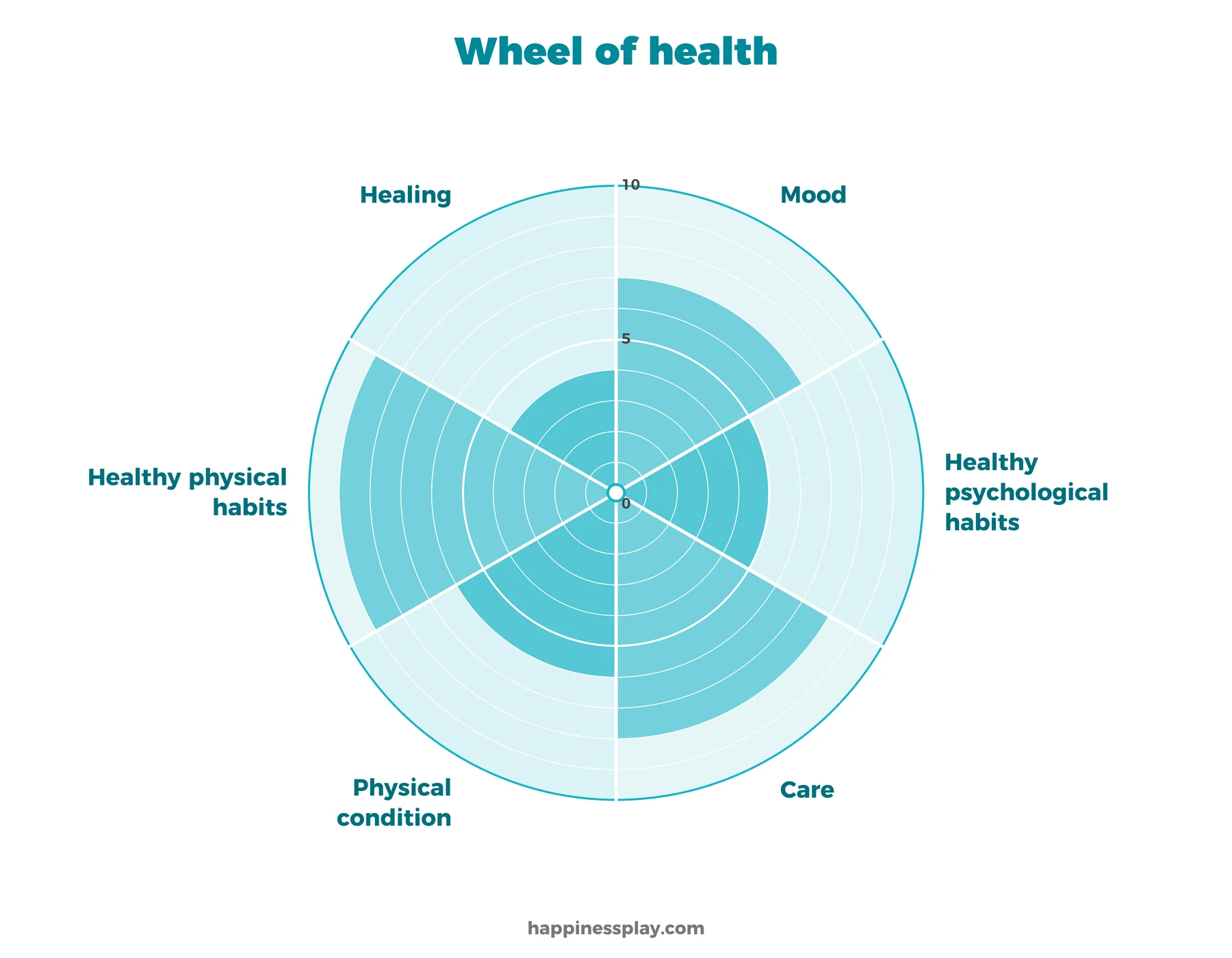
As in any wheel of life, you will need a blank sheet of paper and a circle divided into six sectors, as shown in the figure. Score each wedge (area) from zero to ten according to how satisfied you are today. There is no preset scale: it is a personal one. Try not to rack your brain looking for a reference system to work out how to gain one more point. If you hesitate, close your eyes and ask yourself: am I truly happy in this area of my life?
The Health Wheel
In the Health Wheel you will look at your physical and mental hygiene, remembering that social hygiene is covered in other wheels. From both perspectives you will always assess your condition, the habits you adopt to prevent problems, and the actions you take when you feel unwell. So look at your mood and the healthy psychological habits you apply to prevent harm (care). On the other hand, score your physical condition, the healthy physical habits you keep, and the different remedies you use when you feel unwell. As a guide, you can ask yourself these health coaching questions:
| Area | Description of the area of the health wheel |
| Mood | Do I have any condition that affects my psychological state? (if you don’t, give a high score). Do I feel good in spirit? |
| Healthy psychological habits | Do I look after my mental health and do activities that take me away from tension, nerves, stress…? Do I avoid vices that harm me? Do I try to live without stress? |
| Care | When I feel low, do I take actions that let me recover properly and quickly? Do I rest enough until I have recovered? |
| Physical condition | Do I have any illness that affects my physical state? (if you don’t, give a high score). Do I feel good about my physical appearance? |
| Healthy physical habits | Are my physical hygiene, rest, diet, sport and other self-care adequate? |
| Healing | When I lose my well-being, do I take measures that let me recover satisfactorily? Do I take enough sick leave until I have recovered? |
Do you have a score for every area? This measurement puts your overall view of life into numbers, and you will probably see things differently. Not sure about all the values you chose? Review your scores and change them until you feel comfortable with them. Remember that we never judge a wheel as good or bad: it is simply yours, personal and non-transferable. In the template below you can see how the arcs should look once the scores of the health wheel are in:
Health wheel template
Now is a good moment to start working on the lowest-scoring areas: perhaps some health coaching? Activities to eat better? An exercise to sleep better? Rest assured that the happiness app, Happiness Play, can help you: you can start with these health coaching questions.
When to do the Health Wheel
- When you notice you are tired, sleep badly or find it hard to keep your habits.
- After an illness or sick leave, to see which habits you want to recover.
- When starting a change of habits: eating better, moving more or quitting smoking.
- Every few months, to check whether the changes you planned have improved your health.
Health coaching examples
Which questions and conversations can help me get started in health coaching? We often feel so afraid in certain situations that we prefer to hide them and say nothing, but some examples of questions from a coaching perspective will help us in everyday situations. Remember that coaching does not try to teach or give advice: it starts from the idea that the client already has every resource needed to reach their goals.
Here are some health coaching examples of how coaching sessions work; you will see that they ask powerful questions that make the client think about their own actions.
I want to rest better and more comfortably
Rest is without doubt a very important tool of personal growth coaching, so I invite you to think about how to achieve it:
- What are you really looking for by doing it?
- Are you looking in the right place to achieve it?
- Which people you know can advise you on this?
- Are you truly committed to achieving it, or do you need something else to do it?
I want to improve my eating habits
Remember that to correct yourself is wise, and now is a very good time to begin since you are aware of how you feel. Allow me to suggest you meditate on the way forward with these questions:
- How important is satisfaction in your life?
- Which aspects do not satisfy you, and how are they related to your desired factors or conditions?
- Which personal values are not being honoured because of it?
- Imagine you felt blissful spiritually and religiously: how did you achieve it?
I want to improve my mood and self-esteem
In health coaching it is very important to look for the best way to know yourself. Although you have already come a long way doing it, it will not hurt to reflect on your reasons for this:
- Which facets are you interested in getting to know even better?
- Do you think you give yourself enough attention? And your personal growth?
- How consistent are you with your personal values, and how do you look after them?
- Which actions are you going to take to make it happen, and when?
I want to improve my physical health with new sports habits
To achieve what you set out to do, allow me to suggest some powerful questions that will guide you on your way:
- Tell me, what level of satisfaction do you have in your daily life? Have you considered other approaches to improving your self-esteem that are not physical?
- Which goals do you think you need to set to improve?
- Are you committed to yourself? What do you need to do it?
- With good coaching exercises, when are you going to get started?
I want to take care of my hygiene habits
Nowadays physical appearance has gained a relevance we cannot leave aside, although we can take some of the importance away from it. These questions will help you reflect on it:
- It seems something bothers you: what is it? Is there nothing positive about your personal appearance? How is your self-esteem?
- How important is other people’s opinion to you?
- What are you going to gain and lose with this? Are you going to stay optimistic?
- How committed are you really?
I would like to look after and respect my sexuality
For emotional management in health coaching I recommend you look for information in books, specialised magazines or online. Besides these readings, I suggest you reflect on these questions and wait for the answers to appear within you:
- So far, which aspects do you think you have not managed the way you want? How could you strengthen them?
- Are your expectations about what you want at this moment adequate?
- Imagine you could improve your relationship with yourself: how would you do it?
- Which actions are you going to take to reach your goals? Are you committed to achieving it?
I want to face my illness
It will be important to tell the truth. To find the answer to what you are asking, it will not hurt to reflect a little:
- Is it really what you want?
- What do you gain and what do you lose by doing it?
- What degree of commitment are you willing to make to do it?
- When will you start?
I want to adapt to my treatment
To reach this goal, I suggest you reflect on these questions and wait for the answers to appear within you:
- What are you going to improve?
- Have you checked whether your expectations are adequate?
- How are you going to give yourself the support you need to achieve it?
- Which actions and commitments are you going to take?
I would like to have adequate health
To reach this goal, I suggest you reflect on these questions and wait for the answers to appear within you:
- So far, what could you have looked after more?
- Have you adjusted your expectations to the present moment? What has changed?
- If you could do anything, what would you be doing?
- Which actions are you going to set in motion?
If the wheel of healthy habits interests you, draw your health wheel now
Health and habits: frequently asked questions
Does the health wheel replace a medical check-up?
No. It is a self-reflection tool, and it complements professional care. Use it to prepare for the conversation with your doctor and to follow your own habits.
How do I turn a low score into a habit?
Choose one habit, make it small and give it a trigger. Our values exercise helps you pick a habit you will actually care about, and the life map helps you see what else it affects.
Can stress lower my other scores too?
Often it does. See how the areas relate in the wheel of life guide and in this overview of happiness.
Be kind to yourself when you score. A low number is only a starting point, and improving by a single point is already a good result.
If you are just getting started, read how to start being happy. For better questions, read weak vs powerful coaching questions. For the vocabulary, see the coaching glossary. For more ideas, read how to live without stress.
After this wheel of life you can also do more sub-wheels from the life map
Each sub-wheel breaks one area of your life into eight parts so you can score it in detail:
 Work and career
 Love and relationships
 Money and finances
 Home and living space
 Family and friends
 Leisure and free time
 Personal growth
 The wheel of life

