


Family and friends are the people who know us best and sometimes hurt us most. This wheel does not tell you how to feel about them: it helps you notice which relationships give you energy, which drain it, and where a conversation is overdue.
What are family and friends in the wheel of life?
Family and friends are one of the eight areas of the wheel of life: your relationship with your mother, your father, your children and your close relatives, the friends you can count on and the people you meet every day. It is scored from 0 to 10 according to how satisfied you are today with those relationships.
Family coaching and friendship coaching do not tell you how to treat anyone: they ask you questions so you decide which relationships you want to look after, which ones need a change and what the first step you are going to take is.
Examples of family and friends conditions: eating together on Sundays, good communication with your children, friends who support you when you need them, meeting your friends every week or getting along with your in-laws.
Video: how to do the Family and Friends Wheel step by step

Example of the Relationships Wheel
I don’t know what to do about my family relationships or friendships. If you are looking for exercises to improve your relationships, you are in the right place. Many people are afraid to face their demons and prefer to stay in their comfort zone. But it is time to take personal responsibility and start being happy by discovering everything you like (and also everything you don’t like). As in any wheel of life, you will need a blank sheet of paper and a circle divided into eight sectors, as shown in the figure. Score each wedge (area) from zero to ten according to how satisfied you are today. There is no preset scale: it is a personal one. Try not to rack your brain looking for a reference system to work out how to gain one more point. If you hesitate, close your eyes and ask yourself: am I truly happy in this area of my life?
The Family and Friends Wheel
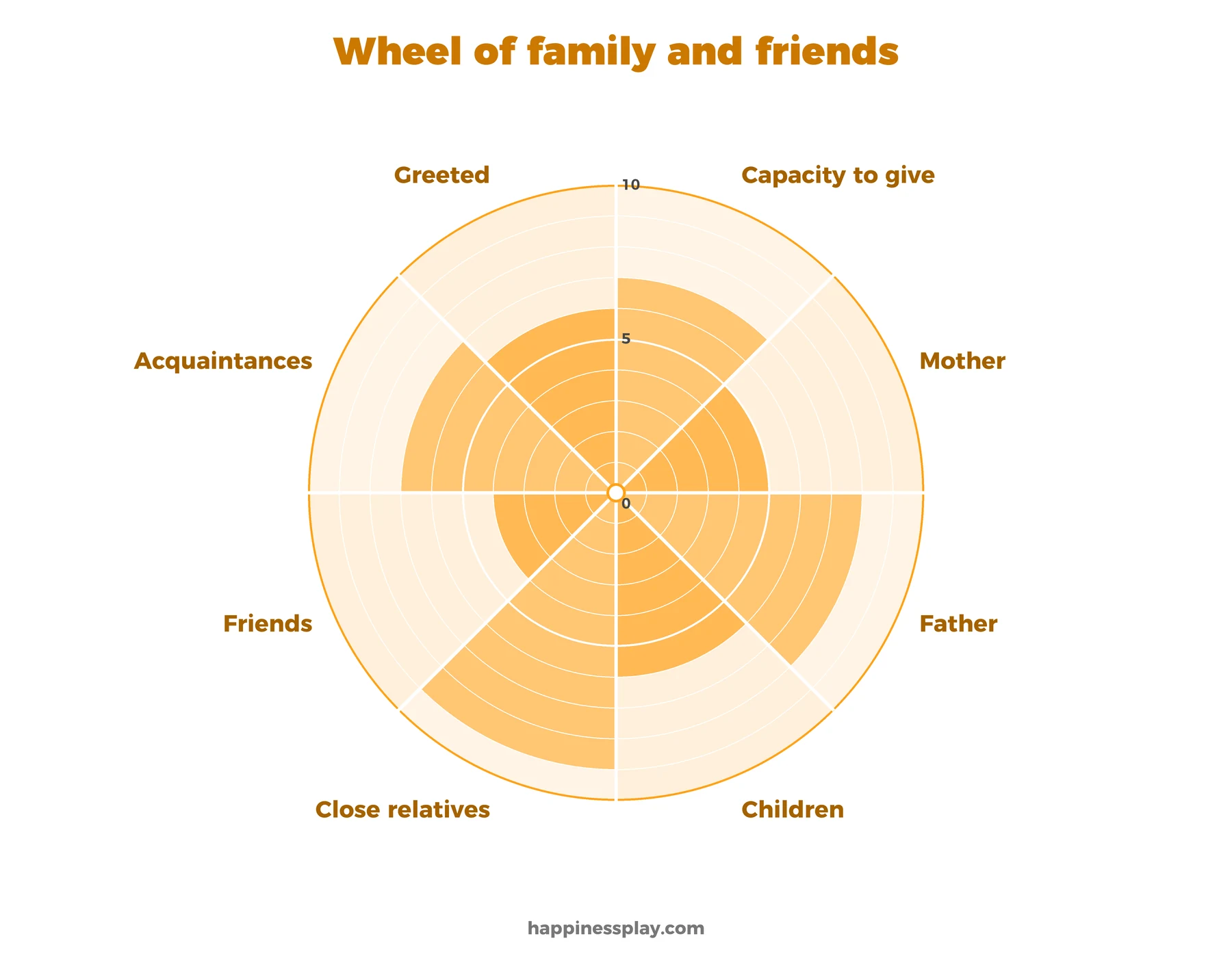
In the Family and Friends Wheel you assess your capacity to form new relationships, as well as the affection you have with your mother, father, children or other close relatives. When you score children, relatives, friends and so on, a low score is a sign that you want to have them and don’t, or that you have them and don’t like them. If you have lost a relative, simply score how you feel overall about the relationship you had. In a life map you will also assess your closest friends, your usual acquaintances and the people you habitually greet. Below you will find family coaching questions for each situation.
| Area | Description of the area of the family and friends wheel |
| Capacity to give | Am I satisfied with my ability to find new friends or to preserve my family relationships? Do I communicate properly with people? Am I someone who does not respect the rules of my family and friends? |
| Mother | Am I satisfied with the relationship I have with my mother? |
| Father | Am I satisfied with the relationship I have with my father? |
| Children | Am I satisfied with the relationship I have with my children? If I don’t have them and I want them, am I satisfied with what I am doing to have them? |
| Close relatives | How do I feel about my relationships with close relatives, that is, with my siblings, grandparents, cousins, aunts and uncles, among others? |
| Friends | Am I satisfied with the friends I have? Can I really count on them when I need them? Do they support me enough? By friends we mean the ones who always come back, whom you don’t need to worry about. |
| Acquaintances | Am I comfortable with the acquaintances I have? Do I think I have too many? |
| Greeted | Am I comfortable with the people nearby whom I usually greet? Do I think I should have more people around me? |
Do you have a score for every area? This measurement puts your overall view of life into numbers, and you will probably see things differently. Not sure about all the values you chose? Review your scores and change them until you feel comfortable with them. Remember that we never judge a wheel as good or bad: it is simply yours, personal and non-transferable. In the template below you can see how the arcs should look once the scores are in.
If looking after your family and friends interests you, draw your family and friends wheel
Family and friends: quick answers
Is it normal to score family and friends very differently?
Very normal. Many people feel close to friends and distant from relatives, or the other way round. Scoring them separately makes the difference visible so you can decide where to put your effort. A life map is a good way to draw it.
What if a relationship cannot be repaired?
Then the question changes from how to fix it to how to live well with the distance. Your values are a useful guide to what you are willing to accept.
Is there research on relationships and happiness?
Yes, and it is one of the strongest findings we have. We summarise it in what science says about happiness.
You do not have to repair everything at once. One honest message or one invitation can be enough to start, and the wheel will show you in a few weeks whether it worked.
If you are just getting started, read how to start being happy. For better questions, read weak vs powerful coaching questions.
After this wheel of life you can also do more sub-wheels from the life map
Each sub-wheel breaks one area of your life into eight parts so you can score it in detail:
 Work and career
 Love and relationships
 Money and finances
 Home and living space
 Health and habits
 Leisure and free time
 Personal growth
 The wheel of life
Family and friends wheel template
You don’t need to know what an algorithm is to know it is a good moment to start working on the lowest-scoring areas. Perhaps some relationship coaching? Activities to improve communication with others? An exercise to bond better? Rest assured that the happiness app, Happiness Play, can help you: you can start with these family coaching questions.
When to do the Family and Friends Wheel
- When you feel you are drifting away from your family or friends and don’t know where to start.
- After a family conflict, to see which relationships you want to look after and which part depends on you.
- At a change of stage: a move, the birth of a child, a separation or the loss of someone close.
- Every few months, to check whether the changes you planned have improved your relationships.
Coaching exercises to improve relationships
We often feel so afraid in certain situations that we prefer to hide them and say nothing, but some examples of questions from a family coaching perspective will help us in everyday situations. Remember that coaching does not try to teach or give advice: it starts from the idea that the client already has every resource needed to reach their goals. To manage happiness in the family, we share some examples of how family coaching sessions work; you will see that they ask powerful questions that make the client think about their own actions.
I want to have a good relationship with my family
The fact that you want a good relationship with your family says a lot about you. To help you achieve it, I would like to suggest you reflect on the questions I am about to ask and see what you find:
- How can you use your personal resources to achieve it?
- If you could have your ideal partner, what would they be like? How could you make it real? Which steps should you take? What could help you?
- Which other perspectives come to mind that will help you achieve it?
- How could you involve your family in reaching the goal?
- Is there anything stopping you from putting it into practice? If so, how could you solve it? If not, what do you need to start right now?
I would like to handle conflicts with my family differently
Conflicts are completely natural in social relationships; what matters is knowing how to face them. Having noticed it is already the first step toward handling these moments better, so I suggest you reflect on it through some questions I am about to ask:
- Which aspects would you like to handle differently? When you have tried, how did it turn out?
- If you could say and do what you would like, how do you think it would influence your relationships?
- Have you talked about it with your family? Would you like your family to get involved in the change?
- Now imagine you can achieve what you have set out to do: which steps should you take? Could you plan your time and actions?
- What else do you need to get started?
I would like to be able to communicate with my family
Communication is a fundamental tool for avoiding toxic relationships. It is worth reflecting on the questions I am about to ask, which will surely help you find unexpected answers:
- Which aspects do you want to have within the relationship? How would you like this to become real?
- Which of your personal resources will help you make it real?
- When and how can you get down to work? What would make you start today?
- If you are truly committed, you can start now!
I would like to restore my relationship with my in-laws
Doing a life map may have pointed you to this important matter. Deciding to restore the relationship suggests that something is changing, so to help you achieve it I would like to suggest you reflect on the questions I am about to ask and see what you find:
- Are your expectations achievable? Is it what you really want, or something imposed by circumstances?
- Are you ready to do everything necessary to achieve it? Which steps should you take to move toward what you want?
- How can your necessary and motivating conditions help you achieve what you set out to do?
- Would involving your family in reaching the goal help you? How would you do it?
- Is there anything limiting you from putting it into practice? If so, how could you solve it? If not, what do you need to start right now?
I don’t want to continue the relationship with my family
Before putting affirmative judgments on the table, this is an important enough decision for you to reflect on carefully. I suggest the following reflections:
- How mature is this decision?
- How are you managing your expectations?
- What real effect would this have on your life and on your family?
- Which other alternatives exist?
- Once you have made a decision, when and how are you going to carry it out?
I would like to improve communication with my children
To use a tool like communication more and better, I recommend you reflect on the questions I am about to ask, which will surely help you find unexpected answers:
- Which aspects do you consider could be improved in your relationship with your children?
- Which questions can you ask yourself to make that happen?
- What would you think if you were in your children’s shoes?
- Is it possible to involve your family? How would you like to involve them?
- What would make you get down to work today?
I would like to get along with my in-laws
You have surely heard from famous speakers that family relationships are the most important relationships we establish in our lives, which is why it matters that you want to look after them. I am going to ask you a few questions so you can see what they suggest:
- What will achieving it bring you?
- If you could create the perfect scenario, how could you make it real? What would it be like? How would you feel?
- How can your necessary and motivating conditions help you achieve what you set out to do?
- How could you involve your family in reaching the goal? Is there anyone else who can help you?
- Is there anything limiting you from putting it into practice? If so, how could you solve it? If not, what do you need to start right now?
You can start managing happiness with your family and friends with Happiness Play by clicking here.
Now onlineTry the new Happiness Play: your Wheel of Life, free and in minutes.Open the new website
