


Free time is the one part of life that is entirely ours, yet it is the first to go when we are busy. The leisure wheel asks how much of it you have, how well you use it and whether it really recharges you.
What is leisure in the wheel of life?
Leisure is the free time you choose for yourself: the time you don’t give to work, obligations or household chores, and use to rest, have fun, share with other people and do whatever recharges you. In the wheel of life leisure is one of the areas you score from 0 to 10: it does not measure how many free hours you have, but how satisfied you are with your free time (how much you have, how you make the most of it and how much you enjoy it).
Examples of leisure: reading, watching a series or a film, listening to music, playing sport, going for a walk, meeting friends, going to a concert, travelling, cooking for pleasure, learning something new that nobody asked you to learn or, simply, doing nothing without guilt. There is receptive leisure (you enjoy something others do), active leisure (you do it yourself) and participatory leisure (you share it with other people): the Leisure Wheel measures them separately.
Video: how to do the Leisure Wheel step by step
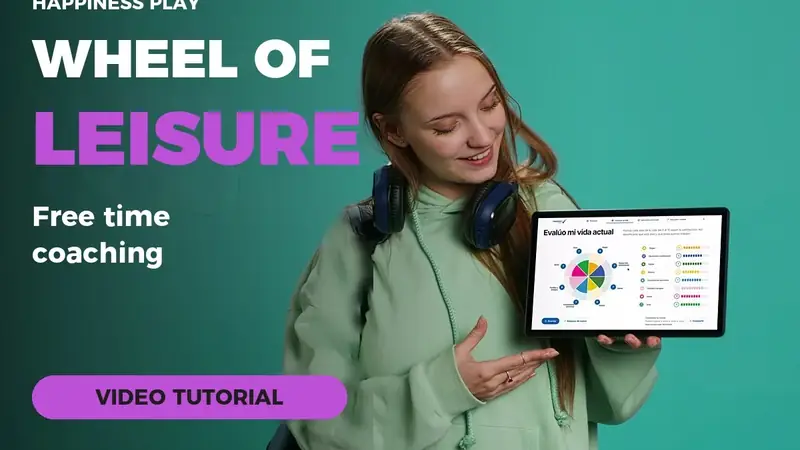
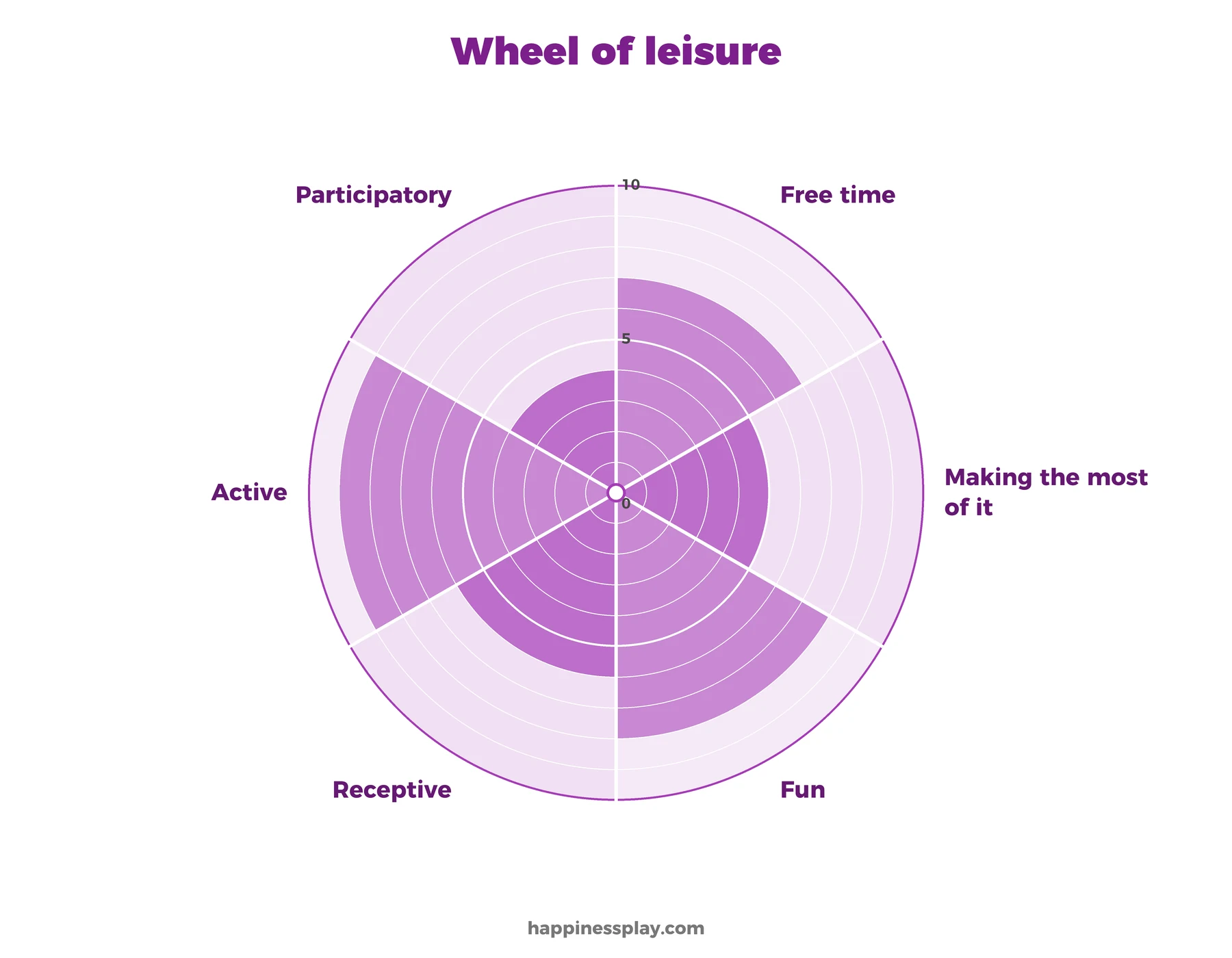
Example of the Leisure Wheel of Life
If you are looking for exercises to improve your free time, you are in the right place. Many people are afraid to face their demons and prefer to stay in their comfort zone. But it is time to take personal responsibility and start being happy by discovering everything you love (and also everything you don’t like). As in any wheel of life, you will need a blank sheet of paper and a circle divided into six sectors, as shown in the figure. Score each wedge (area) from zero to ten according to how satisfied you are today. There is no preset scale: it is a personal one. Try not to rack your brain looking for a reference system to work out how to gain one more point. If you hesitate, close your eyes and ask yourself: am I truly happy in this area of my life?
The Leisure Wheel
This wheel is the piece of the map that should make us enjoy ourselves the most: our leisure. In the Leisure Wheel you assess the free time you have today, how well you use it and how much fun it brings you. Then you assess how involved you are in your leisure, whether receptive, active or even participatory when you do it with other people.
| Area | Description |
| Free time | Do I have enough leisure time? Do I think I should have more? |
| Making the most of it | Do I feel I enjoy the free time I have? Do I really make the most of my leisure? |
| Fun | Do I have enough fun in my leisure time? Do I feel bored and not enjoy it? Remember that a person’s tastes differ a lot from one person to another. |
| Receptive | How do I rate the activities I do such as reading, listening to music, enjoying films, TV, shows, looking at photos, studying, etc.? |
| Active | Am I satisfied playing a sport, practising a hobby such as model aircraft, playing video games, etc.? |
| Participatory | How do I rate the leisure in which I take part with other people, such as meeting friends or family, team games and/or sports, etc.? Am I satisfied with the social relationships I have when I enjoy my leisure? |
Do you have a score for every area (wedge)? This measurement puts your overall view of life into numbers, and you will probably see things differently. Not sure about all the values you chose? Review your scores and change them until you feel comfortable with them. Remember that we never judge a wheel as good or bad: it is simply yours, personal and non-transferable. In the template below you can see how the arcs should look once the scores of this leisure and free time wheel are in.
If you are interested in leisure in the wheel of life, draw your leisure wheel now
Leisure and free time: common questions
Is leisure the same as resting?
Not always. Rest recovers energy; leisure is what you choose because it gives you pleasure, from a hobby to a long walk. Both belong in a balanced week.
How do I find time if I am always busy?
Start by choosing what matters most. Doing a life purpose exercise and a values exercise gives you the criteria to say no to the rest, and the Autocoaching methodology explains how to turn it into a plan.
Can I share leisure with my family?
Yes, and it often helps. See the family and friends wheel for ideas on spending time with people you love.
Block one slot this week for something you enjoy and protect it as you would a meeting. Then score the wheel again and see what changed.
If you are just getting started, read how to start being happy. For better questions, read weak vs powerful coaching questions. To list what you want, read how to manage what you want. To put it into practice, read how to make changes in your life.
After this wheel of life you can also do more sub-wheels from the life map
Each sub-wheel breaks one area of your life into eight parts so you can score it in detail:
 Work and career
 Love and relationships
 Money and finances
 Home and living space
 Family and friends
 Health and habits
 Personal growth
 The wheel of life
Leisure wheel of life template
If you know how to manage happiness, now is a good moment to start working on the lowest-scoring areas. Perhaps some leisure coaching? Activities to improve our free time? An exercise to innovate in how we enjoy ourselves? Rest assured that the happiness app, Happiness Play, can help you. You can start with these leisure coaching questions.
When to do the Leisure Wheel
- When you feel you have no free time or, if you do, you don’t enjoy it.
- When your leisure always boils down to the same thing (your phone, the TV) and you miss variety.
- Before a holiday or a change of schedule, to decide what to spend that time on.
- Every few months, to see how your leisure is evolving.
Coaching exercises to improve your free time
We often feel so afraid in certain situations that we prefer to hide them and say nothing, but some examples of questions from a coaching perspective will help us in everyday situations. Remember that coaching does not try to teach or give advice: it starts from the idea that the client already has every resource needed to reach their goals. We share some examples of how leisure is worked on in coaching sessions; you will see that they ask powerful questions that make the client think about their own actions.
I want my leisure activities to be relaxing
Regarding relaxing activities, I suggest that in a calm moment, perhaps while walking or meditating, you think about the following questions:
- What need is there in your life for relaxing activities, and how does it relate to your stress level?
- Have you thought about which other activities (besides leisure) could relax you? What do your motivating and necessary conditions tell you about it?
- Who can help you improve this aspect?
- When are you going to do it?
I want my leisure activities to be diverse
To develop diverse and varied activities, I think these questions will help you find out how:
- Which kind of diversity attracts your motivating and necessary conditions the most?
- If you could do anything, what do you see yourself doing?
- Do you remember what you enjoy most about leisure, and how you can include it in your next activities?
- When are you going to get started, and who can help you achieve it?
I want my leisure activities to be satisfying
For your leisure activities to be satisfying, I suggest you reflect on these questions:
- What does satisfaction mean to you?
- Have you considered which motivating and necessary conditions a satisfying activity must have?
- What information do you need about possible activities, and where can you get it?
- What do you need to overcome the obstacles in your way?
I want my leisure activities to be innovative
About innovative activities, by reflecting a little on these questions you will surely find something new:
- What interests you most when starting a new activity?
- Which options are you not considering because you don’t know about them?
- Could you open new perspectives on unfamiliar activities?
- Which ideas come to mind? Where can you find information about them?
I want to do leisure activities with a certain frequency
To reach this goal, how about we dive a little deeper inside you:
- What do you gain and what do you lose with the frequency you want?
- What role do your motivating and necessary conditions play in this?
- How is your time management going?
- What do you need to overcome the obstacles in your way?
I want to do leisure activities in a place with certain characteristics (luxurious, simple…)
This seems to mean a lot to you. To be more aware of the possibilities you have, I suggest you reflect on:
- What is important about doing it in a particular place?
- Which expectations are you generating?
- How do you think you could widen your options? What information do you need?
- Who can help you achieve it?
I want to do leisure activities with friends
This is important enough, since it involves your friends, that I suggest you reflect on these questions:
- What is stopping you from doing it? Which expectations does each of you have, and how can you align them?
- Which activities have you already done, and which were the most satisfying?
- Is time management an important condition? How can you overcome this obstacle?
- Who do you think can help you get it started?
I want to do leisure activities on my own
To clarify a little more, I suggest you reflect on these questions:
- How important is it for you to do activities individually? What stops you from getting started?
- Which expectations are you generating about it?
- Is there something you have dreamed of doing but haven’t, for lack of time, resources or information?
- When are you going to make the change?
I want my leisure to include free activities
To get even more out of your activities, I suggest you reflect on these common questions from personal financial coaching:
- How important is money for you to be able to do activities?
- Are you taking your motivating and necessary conditions into account?
- Which kind of activities do you consider the most desirable when getting started?
- When are you going to commit to doing it?
I want more free time to do leisure activities
Having free time to enjoy our leisure adds quality to our lives, so if you take a moment to answer these questions you will discover something:
- What is the most desirable thing about this situation?
- Which part of your potential are you not using to achieve it?
- What do you gain and what do you lose by not getting started?
- Is there something you have dreamed of for a long time and not started for lack of time?
I have too much free time and want to organise it better to fill it with leisure activities
Too much free time can be a problem if we don’t know how to organise ourselves properly, so I suggest you dig a little deeper:
- Are you paying attention to your motivating and necessary conditions?
- Which leisure activities do you enjoy?
- What has to happen for you to wake up and get down to work?
- Have you thought about starting today?
I want my leisure activities to be cultural
I think you have chosen a path of leisure that can give you a lot of satisfaction, and it would be advisable to pay attention to these questions so they light your way:
- What role do your motivating and necessary conditions play? Which activities are the most attractive to you?
- Are your expectations adequate? What do cultural activities bring you?
- What do you need to overcome the obstacles in your way?
- What has to happen for you to achieve it right now?
How to find your next TOP holiday destination
Many people are dreaming of their own paradise right now, but do you know how to find your TOP holiday destination? Shall we dream for a while about the accommodation of your next holiday? Here are some ideas so that next time it is your best holiday yet.
What is your next destination?
To know what we like at any moment, it helps to know our necessary and motivating conditions (or factors, as I call them in the Autocoaching methodology). They are personal preferences that can be classified into two types:
- Necessary conditions are the minimum requirements for something to count as accommodation and that, if not met, will leave you dissatisfied. Which are the necessary conditions for accommodation to be to your liking? For example, it should have a bed, and a bathroom with a shower and a toilet. This is what almost everyone would consider essential to call it accommodation.
- And motivating conditions? The list is endless: all the extra details that add value but wouldn’t be a problem if missing. For example, cable TV with lots of channels when you arrive at night? Pretty bottles of soaps and bath salts? Your favourite drinks from a minibar? Free phone calls? High-speed wifi? Let your imagination run and always think of new possibilities… and so appreciate new things!
The list of necessary conditions is usually simple to draw up and includes the basics, everything without which you could not establish the concept. For example, if there is no bed, you may think it is a tent. The list of motivating conditions can be very long for some people. It includes the accessory: all the extras that are always welcome but are not minimum conditions for your notion of accommodation. When I think about where to stay I have always had a hotel or hostel (however modest) in mind with this small list of preferences. The idea is that you make your list and use mine as a reference to reflect on yours:
Necessary and motivating conditions of accommodation
Necessary conditions
- Good prices
- That I feel at home
- That there is someone who knows how to listen
- A good bed
- A door and a big window
- A bathroom that smells clean
- A good shower with hot water
- That I can pay by credit card
- That it is not noisy
Motivating conditions
- A TV where I can watch lots of YouTube channels, or Netflix itself
- A good smile in the morning
- A sauna or somewhere to relax
- A dental kit and soaps so I don’t have to carry a full toilet bag
- Air conditioning
- Someone who listens to others
- …
I have been visiting hotels in many countries for years and my list has formed over time. Without doubt, my great addition has been “that I feel at home”, an option that is only possible when you return to a place often. So if you want to know your next destination, remember that these conditions are mine and that yours are probably very different. For example, I have friends who spend all day in the gym; others who need a games console in the room to pass the evenings; and others who like to cook their own food every day. Every person is a world. Dare to make your list? It will be very useful when we see how the rules that manage our tastes work…
What makes a destination TOP
Your tastes change throughout life, don’t they? And they can even differ depending on the people you enjoy your holidays with. Now that you have the list of necessary and motivating conditions for your dream accommodation, here are the rules that govern how they work. If you think them through with an example of your own, you will be surprised how curious they are.
First rule: motivating conditions can cover up a necessary condition
Necessary conditions must be met for you to really consider something accommodation, but this rule adds a striking detail. Remember my list? Pick one of the necessary conditions: “a good shower”. Now imagine that on arrival you are offered a room with a jacuzzi but no shower. On paper it sounds great and, for most mortals, even very luxurious. A doubt assails you: shower or jacuzzi? Which is more attractive? Notice how the rule works: having a jacuzzi, which in principle was a motivating condition, makes you give less importance to a necessary one missing. But how many days will pass until you want the shower again? The lack of the necessary condition remains, and over time the soothing effect of the motivating one that covered it fades and disappears.
Second rule: motivating conditions become necessary over time
Imagine you have been in the super apartment for a few days (this time varies from person to person) and you have got used to the jacuzzi. It has become so habitual that it has stopped being a motivating condition and, from now on, you will not be comfortable in any accommodation without both a jacuzzi and a shower. As the saying goes, one gets used to the good very quickly. Understanding life means knowing that, over time, the motivating condition has become necessary. Some people take minutes to get used to the good; others, a lifetime. And notice a curiosity: once the second rule is met, you will only want accommodation with a shower and a jacuzzi. Having a jacuzzi will no longer be a motivating condition, so the first rule stops working. The lack of a shower will keep complicating your life, and every morning when you wake up you will want a quick shower without the whole jacuzzi performance.
Third rule: necessary conditions can also become motivating over time
With age, I never stop being surprised by how some things from the past stop seeming so important. I know many friends who years ago loved going camping all over the world and saw it as essential for their leisure. As they have grown older (and gone through the odd financial setback), that need has changed, because now they want to spend their holidays in a good apartment that offers every service needed to feel at home.
A reflection on your TOP destination
Do you know yet what your TOP holiday destination will be? As a conclusion, remember that your needs can change radically, and that should not bother you in the least. What matters is knowing that your wishes evolve and change. If you internalise this idea, you will not worry that, with age, things follow their life cycle, however much you may not want to change.
Now onlineTry the new Happiness Play: your Wheel of Life, free and in minutes.Open the new website
