

If you only have ten minutes today, this is the best way to spend them on yourself: score eight areas of your life from 0 to 10, look at the shape of the wheel, and pick one thing to change first.
The wheel of life (also called the life wheel or circle of life) is a coaching tool that shows, in a single drawing, how satisfied you are with each area of your life: money, work, leisure, love, home, family and friends, health and personal growth. You score every area from 0 to 10, and the shape that comes out tells you where to start managing your happiness.
This guide explains how to make one and how to read it. You can draw yours right now with the interactive template further down this page, and you do not need to leave your email to use it.
- What is a wheel of life for?
- How to make a wheel of life
- Draw your wheel online
- How to read your wheel of life
- Wheel of life template
- The magnetic wheel of life
- The life map and the sub-wheels
- Who invented the wheel of life?
What is a wheel of life for?
Are things really as bad as we tend to think? Or is there one area of life that keeps us feeling like victims all day long? Before trying to fix everything at once, it helps to see where the problem actually is. The wheel of life gives you a snapshot of how happy you are today, and that is why it is the first tool of the Autocoaching methodology: it looks at your life from the widest angle first, so that you can later understand, piece by piece, every ingredient it is made of.
How to make a wheel of life, step by step
You only need a blank sheet of paper. Draw a circle and divide it into eight equal sectors, like the one in the figure below. Around the circle, write the eight big themes that shape a life, in any order: health, love, family and friends, money, living environment (your home), leisure, personal growth and professional development (work). The drawing looks like a round cheese cut into portions, which is why some people call the areas “slices”.
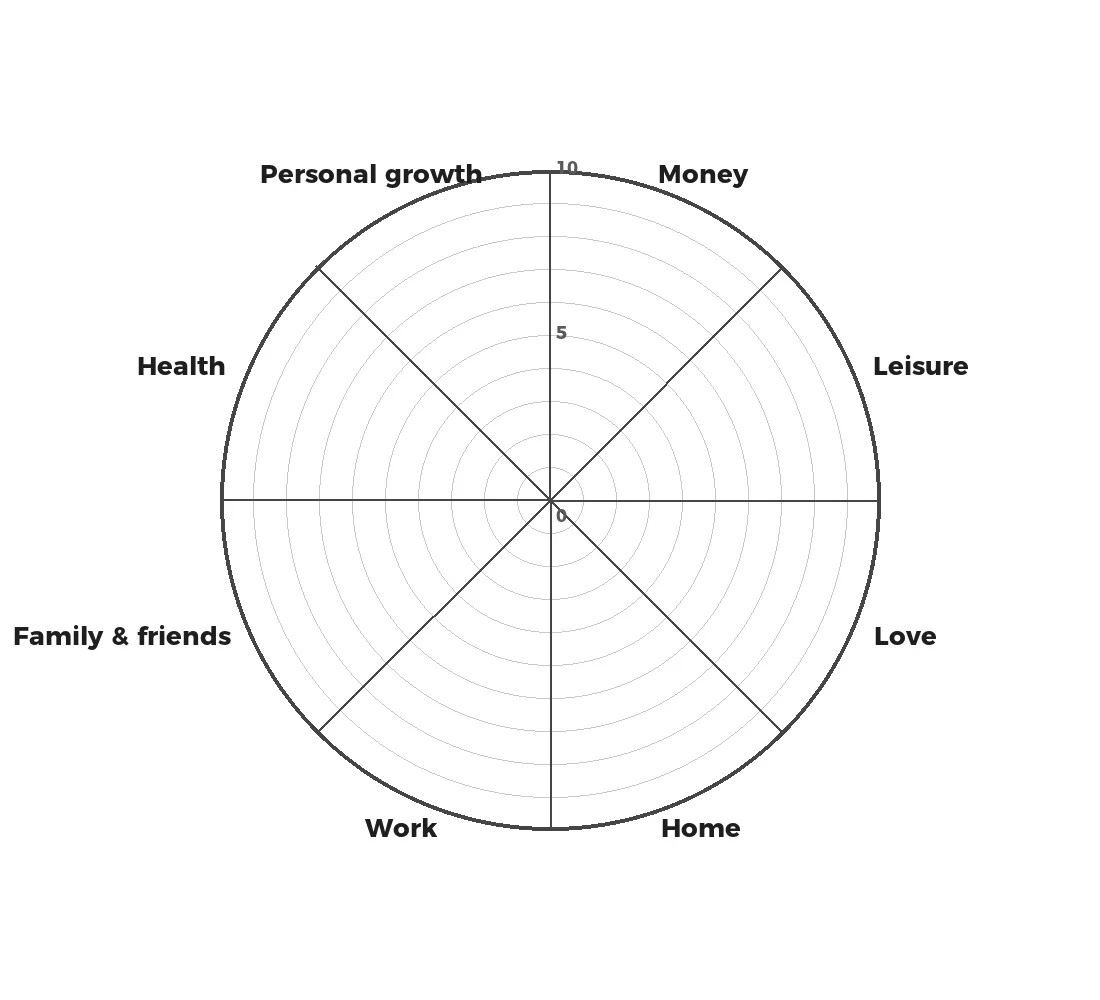
Now give each slice a score from zero to ten: how happy or satisfied you feel today in that area. There is no objective way to do it, because the score is personal. Do not waste time looking for a reference system to work out how to gain one more point. If you hesitate, close your eyes and ask yourself: on a scale from zero to ten, how happy am I right now in this part of my life? These examples can help you understand what each slice covers:
- Money: does your income let you live the way you want? Do your debts weigh on you? Are you comfortable with the money you handle every day? Someone who always dreamed of a healthy bank balance and a paid-off mortgage would give a ten to having achieved it. If you live on the edge, the mortgage is too big and you scold yourself daily for not saving more, a three may be closer. The score is simply your satisfaction today.
- Work or professional development: do you get up looking forward to your job? Do you feel motivated by what you do? Do you get along with your manager and colleagues, or would you rather be your own boss? Maybe you lost your job and you are looking for a new one. When you finish this exercise you can go deeper with the professional wheel of life.
- Leisure: do you enjoy your free time? Quality usually matters more than quantity. If another area steals your time (work, family, a relationship), lower the score of that slice and try to rate leisure on its own. A high score means you enjoy yourself whatever you do; a very low one means you are bored and do not know what to do with your time. Again, it depends on how your experience compares with your expectations.
- Love: how is your relationship? Or, if you are single, how do you feel about it? Having a long-term partner or a string of short relationships is not what counts: there are no winning or losing formulas, only the score that matches how you live love at this moment. Newlyweds will probably give a high number, but are you sure? Sometimes people marry because it seemed the right thing to do. If you have just broken up, the score may be low, unless you are happy to be single again. Once you finish this first wheel you can try the love wheel, a great exercise to do as a couple.
- Home, or living environment: the place where you live and everything around it. Are you comfortable there? Do you like your house, your neighbourhood, your city and your country? Maybe you have just moved and have not settled in yet, or you still live with your parents in a cosy house but miss your freedom. Is your home tidy, or do you hate how it looks and never get round to changing it?
- Family and friends: the relationships of your private life. How do you get on with your parents, in-laws, children, friends and close ones? Do you talk to your relatives even if you rarely see them? Do you have a few lifelong friends or a long list of acquaintances? Are they there when you need them? Feel free to split this slice in two and give two scores: some people cannot stand their family but have excellent friends, and the opposite is just as common.
- Health: are you happy with your physical and mental state? Perhaps it is time for a healthier habit: quit smoking, exercise, eat better or stop worrying about everything. If you have been through a serious illness, you know that health comes before anything else.
- Personal growth: do you feel fulfilled doing what you always wanted to do? Apart from your job, maybe you want to learn a language, collect antiques, study a faraway culture or volunteer. These are only examples of the things you have always wanted to learn or try. If everything feels fine and you cannot think of anything missing, ask yourself what keeps you reading.
Scoring every area turns your overall impression of life into something you can look at, and you will probably see things differently. Not sure about a number? Review it and change it until you feel comfortable.
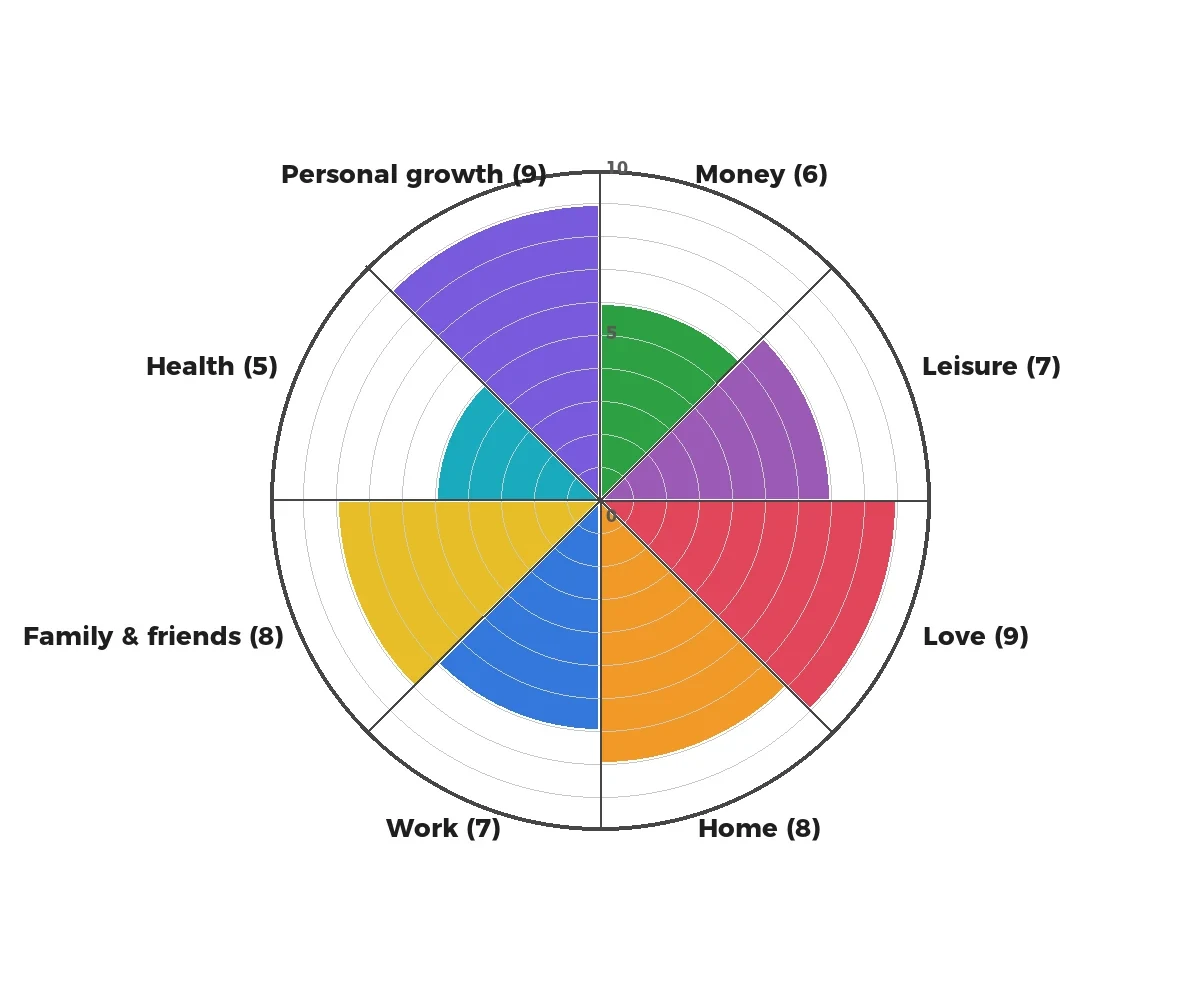
With all the scores written down, it is time to draw. Split each of the eight sectors into ten segments and colour in as many as each score says. When you finish you should get a figure like this one. A picture is worth a thousand words: what does your snapshot look like today?
Prefer not to draw it? Make your wheel of life online
Score the eight areas in the template below and the wheel draws itself. You can also open it on its own page: your wheel of life online.
Wheel of life: frequently asked questions
How often should I redo my wheel of life?
Every few weeks if you are working on a change, or once or twice a year as a general check-in. Our online wheel of life lets you repeat the exercise over time and compare.
Is a perfect wheel the goal?
No. A perfectly round wheel at 10 is not the point. Happiness is personal, and what matters is that each score reflects what you want. For more, read what science says about happiness.
What do I do next once I have my scores?
Choose the lowest score you care about and work on that area with its sub-wheel, then connect it to your life purpose and the Autocoaching methodology.
The wheel is only the beginning. The real work starts when you choose one change, set a date and score again.
How to read your wheel of life
Imagine riding a bicycle whose wheels look like the one you have just drawn. Would the ride be smooth, or would you bounce along the whole way? For most people it would be anything but easy. This small exercise, very common in coaching and mentoring sessions and with chief happiness officers, should make you think about how satisfied you are with your life. Take a deep breath and keep the figure in mind with your eyes closed. It is only a picture, but it is worth being aware of it, because you will work with it a lot.
Time matters too. In economics, the exchange rate between a euro and a dollar is not the same today as it will be in a year. How would you have scored each area over the last few years? The way we give points changes with experience, but that is no reason to skip the process of managing our happiness. Measuring this way is our own personal science: not every science measures with perfect accuracy (physics is exact, yet it cannot pin down both the position and the speed of an electron, as the Heisenberg uncertainty principle shows). Making your own wheels with this method is how you will track your happiness little by little.
No wheel is good or bad: it is simply yours, personal and non-transferable. These tips will help you read the scores of any wheel of life:
- However high or low your scores are, do not obsess over them. There is no need to decide that everything is awful, or that everything is perfect and nobody understands you. From now on this awareness is yours alone. Greeting yourself with an inner smile, whatever good and bad you carry, is the first condition to improve.
- If every score came out as zero, you may have forgotten how to say something kind. It could be a good moment to find something nice to say, even about yourself.
- It is time to accept that some things are better and some worse. Radical pessimism is out, even in happiness management, which also avoids self-deception.
- If you gave yourself a ten in everything, congratulations. Put this exercise aside and come back when something, however small, is bothering or worrying you.
- The best-scored areas should remind you of everything good you have and motivate you to work on the lowest ones. However badly things go, there is always something good in life, and forgetting it helps little when it comes to enjoying life.
- Which area matters most to you? They are not all equally important, and the order changes over a lifetime. A values exercise can help you decide. Many people only look after their health when it fails, and then realise it was the most important area all along.
The wheel of life is also useful at work. In Mexico, for example, it supports compliance with standard NOM-035, which regulates psychosocial risk factors.
Wheel of life template: free and no email needed
Many “free” wheel of life templates ask for your email before you can download them. Ours does not. The interactive template above is a free coaching tool: no email, nothing to buy and no opinion to give. It will give you a first picture of the areas of your life you want to improve, always relying on what already works.
The aim is to make as many wheels as you can, and then build your life map. If you would like to go deeper, the book “Autocoaching para despertar” explains each area of life with coaching tricks and works well alongside Happiness Play: see the books.
The magnetic wheel of life
Happiness Play also created a magnetic version of the wheel of life: a thin square metal sheet with words and symbols that represent each area, which you can stick on your fridge as a daily reminder of your improvement process. It is a patented Happiness Play product (formerly Autocoaching) and was sold in some Spanish bookshops.
What is the life map?
The life map is a set of wheels of life that photographs your happiness in every part of your life. It is the starting point of happiness management, because it breaks down the main ingredients needed to understand a person’s happiness. The book “Autocoaching para despertar” develops it in detail: the wheel of life sits in the centre of the sheet and the sub-wheels are added around it, clockwise. Start with the life map and you will discover the different sub-wheels of your life.
You can also make your wheel of life online with the Happiness Play assistant, choose what you want from an extensive catalogue and be guided through the changes you decide to make. Start using Happiness Play for free.
Once you have your wheel of life, you can go on with the sub-wheels of the life map. Each one breaks an area into eight parts so you can score it in detail:
 Work and career
 Love and relationships
 Money and finances
 Home and living space
 Family and friends
 Health and habits
 Leisure and free time
 Personal growth
Who invented the wheel of life?
It is sometimes linked by mistake to the book The Wheel of Life by Elisabeth Kubler-Ross, to Paul J. Meyer (a pioneer of personal and professional development), or even to Pedro Amador, who created the magnetic version. In fact, the graphic representation of the areas of life goes back to Buddhism, where we find the Tibetan Buddhist wheel of life, also known as the wheel of karma.
Now onlineTry the new Happiness Play: your Wheel of Life, free and in minutes.Open the new website
