

Can happiness be measured? Can you measure love? The honest answer is no: neither is a physical quantity. You cannot equalise them, and you certainly cannot add them up like metres or kilograms. When someone is two metres tall, we all picture a tall person, but nobody can say one person is a 10 in happiness and mean the same as the next, because that value can be different for each of us.
Can you measure love and happiness?
What does exist are personal tools. The wheel of life (or wheel of happiness) and the love wheel let you score areas for your own use, for example to compare yourself today with a month ago. They are not a universal measure that you can use to compare yourself with someone else.
There is also a ranking: the World Happiness Report, an annual publication supported by the United Nations that ranks countries by how people rate their lives, along with factors such as GDP per capita. We look at its latest edition in the best information about happiness. It is a useful tool for governments, but whatever it is called, measuring organizational happiness or how happy employees are does not turn people into machines. Workplace climate has been managed for years by industrial psychology, and now some self-styled gurus have turned happiness into a marketing mantra.
A philosophical point: quality cannot be counted
Business scholar Queralt Prat-i-Pubill argues that if we think of happiness like beauty, love or anything we value, it is a qualitative judgement that cannot be quantified, because the abstraction that makes counting possible always leaves out the quality. In other words, there are two ways of knowing reality: one abstract, which allows numbers, and one concrete, which is qualitative. A question about happiness belongs to the second, so the answer depends on the person and nobody, not even the most expert, can question it.
Rankings and their limits
Those studies have even had the backing of a Nobel laureate, but many happiness experts consider some of their starting assumptions reductionist, because happiness is personal. There are no happier or less happy countries as such, only people who need to find their happiness in the right place. A ranking can also put countries where the human rights of gay people are not respected above others that do respect them, which says a lot about what a single number leaves out.
What validated scales do measure
Neither love nor happiness is a physical quantity, and that does not change. But psychology has spent decades doing something different: asking the person and checking that the answers are stable and consistent with other measures. These scales do not measure how much happiness there is in the world. They record how the person answering rates their own life.
Happiness: two widely used scales
Ed Diener’s satisfaction with life scale has five statements that you rate on a 7-point scale. It assesses the cognitive component of well-being: the overall judgment you make about your life, not how you feel today.
The subjective happiness scale by Sonja Lyubomirsky and Mark Lepper is shorter: only four non-redundant items remained in its final version. It asks how you see yourself and how you compare with others, and it has been tested with 174 Spanish patients with depression.
Love: three components
Robert Sternberg proposes that romantic love has three ingredients: intimacy, passion and commitment. The triangular love scale measures them with 45 questions, and its 15-question short form has been validated in 37 languages with more than 60,000 people. It captures how you perceive your relationship, not love itself.
And by country
The World Happiness Report 2026 again puts Finland at the top, and this edition looks at changes from 2006-2010 to 2023-2025 with a focus on social media. Its ranking rests on a single life evaluation question in which people rate their life on a ladder from 0 to 10. It is an average of ratings, not a thermometer of joy.
These tools are useful for following yourself over time or comparing large groups. They cannot tell you that your 8 is worth the same as someone else’s 8.
Measured or managed?
So can happiness be measured? At a personal level it is natural to say “I am happier today than yesterday”. But in organizations, happiness is not measured, it is managed. That is why Happiness Play offers a full personal assistant to manage it: first you assess your happiness, then you choose what you want in life from a catalogue of preferences, and you set the changes you want to make. Your data stays confidential.
Organizations use Happiness Play Pro to manage the whole process. The idea is to move from worrying to doing something, and to turn pointless complaints into energy for action. Here is how organizations can help people manage their happiness:
- Use a happiness dashboard to analyse workplace climate while supporting employees at every stage.
- A cloud-based system adapted to different devices, with individual follow-up to know how engaged users are.
- Climate statistics by attribute (gender, region and so on) to build action plans.
Start with the myths about happiness and open your eyes to how the marketing works. Beware of cheap courses that promise a diploma from a supposed university on how to “measure happiness” or “measure love”: the science of happiness, like the science of poker or other sciences invented by some marketers, is often just a way to sell.
For the workplace view, read happy employees.
Frequently asked questions about measuring happiness and love
Can you measure love and happiness?
You can measure what a person perceives and reports about their own life or relationship, as long as you ask with a reliable scale. You cannot measure either one the way you measure a meter or a kilogram, because there is no common unit for everyone. The useful comparison is with yourself over time.
How do you measure happiness?
By asking. You can use a validated scale or do it your own way: pick a fixed day each week, rate your happiness from 0 to 10 and note what happened that week. What matters is asking the same question under the same conditions. Today’s number only means something next to the one from a month ago.
How do you measure love?
Researchers do not measure love in the abstract but its parts. In romantic love they usually look at intimacy (trust and closeness), passion and commitment. Each one is scored separately, so the result is a profile of your relationship, not a final grade.
Is there a love calculator?
The ones that promise a percentage from two names or two birth dates are a game, not a measurement. A serious measure uses validated questions and compares your answers with those of many people. Even then, the result describes how you experience the relationship today, and it can change.
How is the happiness ranking of a country calculated?
A sample of people in each country rates their life on a ladder from 0 to 10, and the average is calculated. Then researchers look at factors that go along with those answers, such as income. It is an assessment of life as a whole, not a measure of day-to-day emotions.
Is there a test that tells me how happy I am?
There are many questionnaires, and none is universal. A wheel of life is a better use of your time because it ends with something to do.
Why do people insist on measuring happiness?
Because numbers are convenient for reports and comparisons. The difficulty starts when the number is taken for the thing itself.
Or explore one area at a time:
 Work wheel
 Family and friends wheel
 Health wheel
 Love wheel
 Money wheel
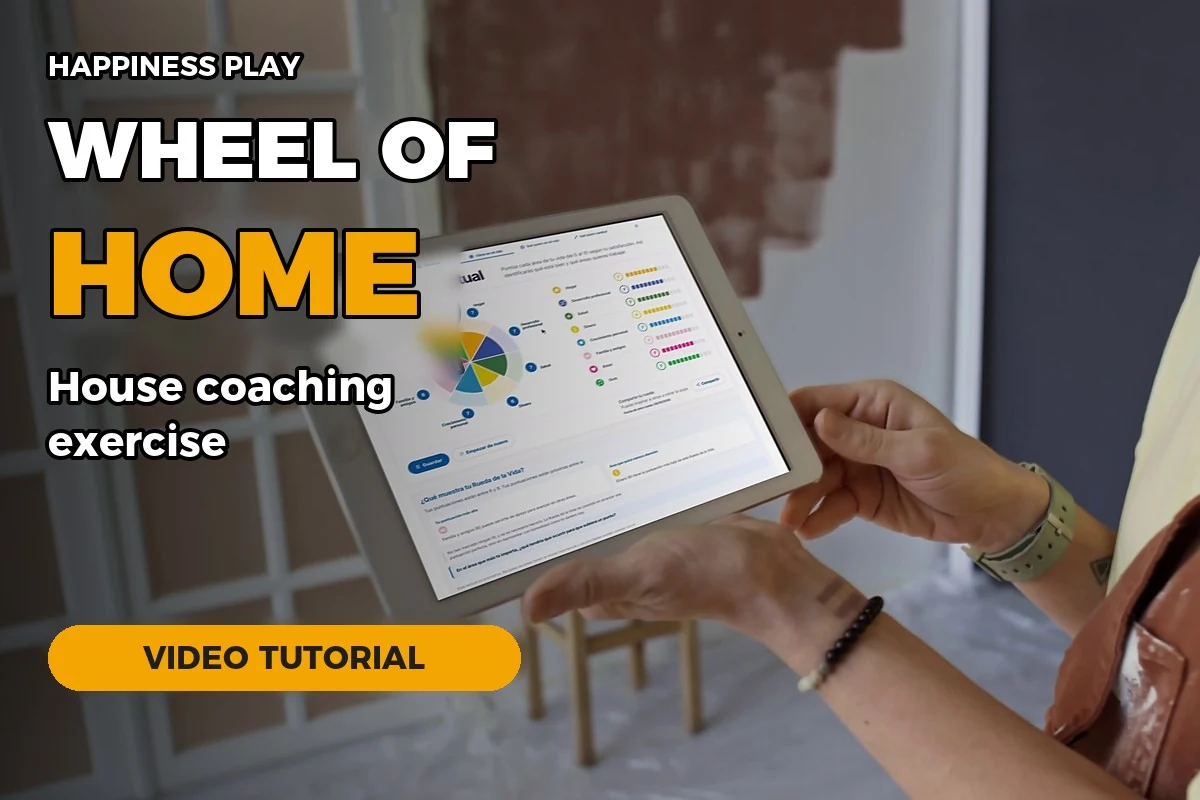 Home wheel
 Leisure wheel
 Personal growth wheel

